The Ultimate Antique Collector Mistakes Guide: 10 Costly Errors That Destroy Value and How to Avoid Them
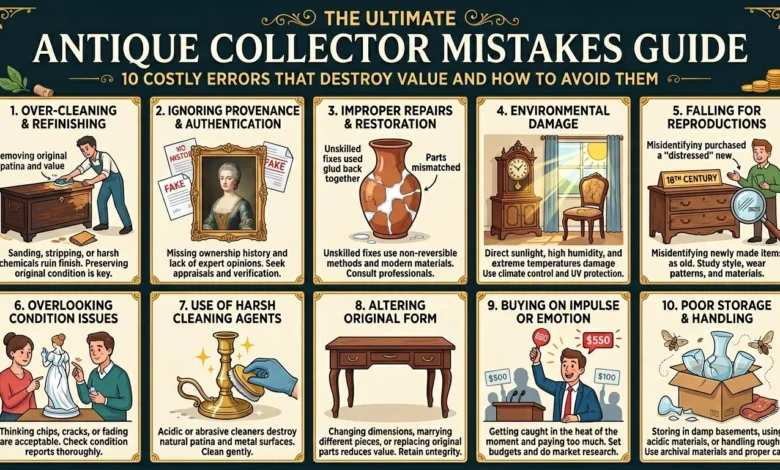
Part 1: Definition Errors – The Most Fundamental Mistake
Before discussing advanced collecting strategies, it is essential to understand the most basic error: misclassifying ordinary old items as antiques.
The 100-Year Rule
According to antique dealers and trade experts, an item must be at least 100 years old to qualify as an antique . Objects from the 1970s or 1980s—no matter how nostalgic they may seem—are not antiques. They are vintage or retro items, and paying antique prices for them is a costly mistake.
Menderes Kaya, a 65-year-old antique dealer who has been in the trade since childhood, warns that ordinary old household items are increasingly marketed as “antiques” with inflated prices on online platforms and social media auctions . Cups, curtains, and other items dating back only a few decades are being sold as nostalgic or antique pieces by unqualified sellers.
Why This Mistake Happens
The confusion is understandable. The word “antique” evokes feelings of age, history, and value. Sellers exploit this emotional response. However, for an item to be classified as an antique, it must meet specific criteria: age (100+ years), rarity, and craftsmanship. Mass-produced items or those lacking artistic or handcrafted value do not qualify, regardless of their age .
| Age Category | Term | Collector Value Potential |
|---|---|---|
| 100+ years | Antique | Highest; requires historical significance and craftsmanship |
| 20–99 years | Vintage | Medium to high; depends on era, brand, and condition |
| Under 20 years | Contemporary/Retro | Low to medium; decorative value only unless limited edition |
Part 2: The Restoration Ruin – Destroying Value with DIY “Improvements”
Perhaps the single most destructive mistake collectors make is attempting to restore or refinish antique furniture themselves. The damage is often irreversible, and the value loss can exceed 50%.
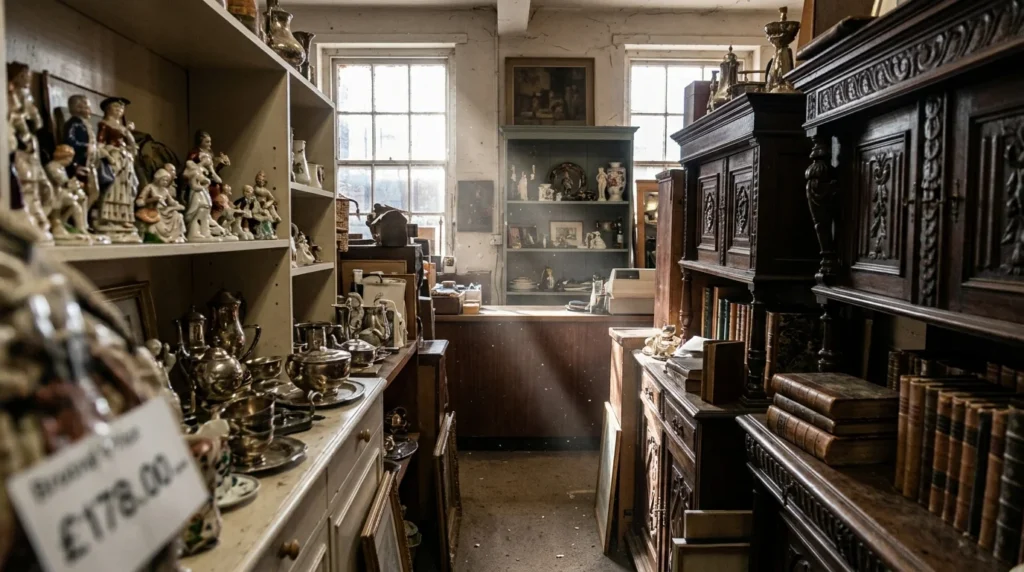
The Case of the Over-Restored Table
One professional appraiser recalls visiting a home to assess what initially appeared to be a reproduction mahogany dining table. On closer inspection, it was revealed to be the real deal—a George III table from the 1770s that had been stripped down and reconditioned with a sickly glossy varnish. It looked brand new. All its history had been removed. The over-restoration reduced its value and made it harder to sell .
What Not to Do
| Mistake | Why It Destroys Value | What to Do Instead |
|---|---|---|
| Sanding the surface | Removes original patina and wood; crisp edges disappear | Dust with soft brush; use barely-damp cloth only if necessary |
| Applying modern varnish or polyurethane | Creates irreversible glossy finish; cannot be removed without damage | Use microcrystalline wax sparingly; preserve original finish |
| Stripping original paint or finish | Destroys historical evidence and collector appeal | Consult professional conservator before any refinishing |
| Over-polishing silver | Wears down hallmarks and thins the metal | Polish sparingly; never use abrasive products |
A professional antiques restorer is invaluable. Wherever possible—and if the budget allows—always hand over furniture restoration to a competent professional with a proven track record, especially if you own something of relatively high value .
When DIY Is Acceptable
If your damaged Victorian balloon-back chair was bought at a car boot sale for only £20, there is no point paying several hundred pounds for professional restoration. Practice on low-value items first. An evening course in antique furniture restoration might be a shrewd investment—but practice on that £20 chair first .
Part 3: Falling for Reproductions and Fakes
The market is flooded with reproductions, and unscrupulous sellers actively fraudulent items as authentic antiques. The economics of fraud are simple: if a genuine antique sells for 450andareproductioncanbemanufacturedfor20, someone will attempt to profit by it .
The Ironstone Wash Basin Scam
During the late 1980s, reproduction Ironstone wash basin sets began appearing at rural auctions alongside genuine examples of English flow blue transferware. What threw people at the time was the marking on these fakes—a “Royal Arms” mark that resembled those used by 19th-century Staffordshire companies .
The difference? Genuine marks are nearly always accompanied by a company name or initials. What would be the point of a marking that did not advertise the maker? The fakes lacked this crucial detail. Eventually, collectors discovered that these pieces were being made in China as late as 1996 .
The “Royal Vienna” Porcelain Confusion
Many collectors refer to porcelain marked with a “beehive” as “Royal Vienna.” The truth is that Royal Vienna is actually a collector’s moniker, and the beehive mark is really a shield. Somewhere along the line, the mark was viewed upside down, and a beehive was born .
More importantly, most “beehive” pieces were not made by the original Imperial and Royal Porcelain Manufactory of Vienna (which operated until 1864) but are later reproductions from the early 1900s or even modern imports. How can you tell the difference? Newer pieces are heavier, the decoration is always applied as a decal rather than hand-painted, and the mark is on top of the glaze. Old pieces have the beehive mark under the glaze .
The Canoe Model Fraud
Miniature canoe models imported from Asia—often made of balsa-type wood and worth about $25—have been fraudulently “aged” and sold as authentic “salesman’s samples” or “antique Indian canoes” for hundreds or even thousands of dollars. Unscrupulous sellers add old trade names, fanciful Native American designs, and crackled varnish surfaces to deceive buyers .
Red Flags for Reproductions
Part 4: Overvaluing Common Items
Sentimentality is a beautiful thing, but it has no place in determining market value. Vintage expert Sally Schwartz, founder of Randolph Street Market, identifies overvaluing items as the most common mistake people make .
The Sentimentality Trap
“People always think their full sets of china, sterling silverware, and crystal are worth more than they are,” Schwartz says. “Certain items, like jewelry and fur coats, don’t bring in what most people think when they try to sell these” .
A beautiful platter that conjures warm memories of family holidays may be priceless to you. To a stranger, it is just a nice plate. Items like this might not be worth the effort to sell at all .
What Has Limited Resale Value
- Full sets of china (most patterns are common; market is flooded)
- Crystal stemware (low demand from younger generations)
- Sterling silver flatware (value primarily in metal weight, not pattern)
- Fur coats (stigmatized, difficult to sell)
- Mass-produced decorative items from mid-20th century
How to Determine Real Value
Before assuming an item is valuable, look for similar items on sites like eBay—but filter by “sold listings” to see what people are actually paying, not just asking prices. Consider calling a local antique store to ask whether they can appraise the item .
Part 5: Ignoring Construction Details
Many buyers focus on visual style alone when evaluating antique furniture, but modern manufacturers replicate historic designs extremely well. Professionals look at construction details—especially joinery and materials—to reveal authenticity .
What to Inspect
| Feature | Authentic Antique | Reproduction/Fake |
|---|---|---|
| Dovetail joints | Hand-cut, slightly irregular, asymmetrical | Machine-cut, perfectly uniform |
| Wood construction | Solid hardwood (oak, walnut, mahogany) | Plywood, MDF, particle board |
| Hardware screws | Uneven slots, natural patina, hand-cut threads | Perfectly uniform Phillips head screws |
| Wear patterns | Concentrated on high-touch areas (arms, edges) | Uniform distressing or sanding |
| Underside/back | Hand-hewn surfaces, irregular tool marks | Machine-sawn, plywood, staples |
Small structural repairs are normal for antiques, but major issues—loose mortise and tenon joints, warped tabletops, cracked legs, woodworm damage—dramatically increase restoration costs. Always inspect these elements before purchasing .
Part 6: Paying for Your Education the Hard Way
Every collector pays for their education eventually. The question is whether you pay with small, recoverable losses or catastrophic ones.
Learning from Mistakes
Pamela Siegel, who grew up working in her mother’s antique shop, shares a painful lesson: “Momma called it ‘paying for your education’ when you spent good money on something that turned out to be a dud. Whether it’s getting excited about a find and overpaying or overlooking a flaw that makes an object virtually worthless, no one in this business avoids paying for their education” .
Her personal mistakes included washing a faux pearl fabric collar with bleach—the nacre on the pearls peeled right off—and trying to glue pearls back onto a Miriam Haskell brooch, ruining a piece that could have been sold as-is. She also purchased several glass and porcelain items with chips and cracks before learning how to carefully inspect them for devaluing damage .
How to Minimize Education Costs
- Start small. Buy low-cost items while learning to identify quality and authenticity.
- Study before you spend. Read reference books, attend antique shows, handle as many genuine pieces as possible.
- Invest in a jeweler’s loupe or magnifying glass. Many flaws are invisible to the naked eye.
- Ask questions. Reputable dealers expect serious buyers to inquire about provenance, restoration history, and age.
Part 7: Over-Relying on Old Scholarship
Collectors who learned their trade decades ago may be operating on outdated or simply incorrect information. The field has advanced significantly, and old assumptions have been overturned.
The Problem with 20th-Century Attributions
According to experienced collectors, the vast majority of information available to collectors in the 20th century was based on local experience of museum staff, antique shop owners, and the few books published on selected topics. Descriptions and attributions were often vague, and not necessarily accurate as to country of production, age, and maker .
For example, the place called Sandwich near Boston was long referred to as a glass production site for many pieces, until much of these claims were proven wrong when glass houses in Czechoslovakia and Bohemia were identified as the actual producers .
It was not until the mid-to-late 1990s that publications became closer to reality regarding antique art glass attributions. Many of the beliefs held by old collectors and published in their books are now known to be severely inaccurate .
Modern Best Practices
- Do not rely solely on old reference books. Cross-reference with current scholarship.
- Be skeptical of attributions that lack documented provenance.
- Recognize that many items were produced in Eastern Europe but attributed to UK or USA manufacturers based on the author’s nationality .
- Use online databases and museum collections as primary sources, not just published guides.
Part 8: Rushing Through Evaluation and Decluttering
Spring cleaning and estate clearance are dangerous times for collectors. The pressure to move quickly leads to costly mistakes.
The Sentimental Purge
“People toss things that are sentimental because they see loose items like piles of paper and personal items like old letters and photos as clutter,” Schwartz warns. “The worst feeling is going back to look for something that triggers memories, and you’ve tossed it out” .
Most personal memorabilia will not sell unless it is tied to a famous person, historical event, or figure—and even then, the market can be very niche. These items are best kept within your family .
The False Urgency
When selling, do not rush to list items without research. A quick sale at a low price is better than no sale, but selling a valuable item for a fraction of its worth because you did not take the time to identify it properly is a painful lesson .
Part 9: Neglecting to Ask the Right Questions
Experienced dealers expect serious buyers to ask detailed questions. If a seller cannot answer basic provenance or restoration questions, that should raise concern .
Questions Every Buyer Should Ask
| Question | Why It Matters |
|---|---|
| Do you know the approximate production decade? | Establishes age and period authenticity |
| Has the furniture been restored or refinished? | Restoration affects value; over-restoration destroys it |
| Are any parts replaced or modernized? | Replacement parts reduce originality and value |
| Where was the piece sourced? | Provenance adds value and authenticity |
| Is there documentation? | Paper trail is the best evidence of age and ownership |
Professional dealers typically disclose restoration work because it affects value. A seller avoiding these questions may simply not know the history—or may be trying to avoid discussing it .
Part 10: The “Ugly” Blind Spot
Many collectors trust their personal taste too much. The items you find unattractive may be the very items another collector is desperate to own.
What Ugly Stuff Sells
Pamela Siegel recalls her mother displaying a Victorian reptile skin handbag with genuine alligator feet decorating it—an item she hated. It did not sit in the shop for long before someone snatched it up. Similarly, a large, ornately carved footed chest that she swore was holding a vampire sold quickly .
“I learned from my mother that the ugly things I think will sit and sit before they sell are often the first items to catch a customer’s eye. So, if you’re frequenting flea markets and thrifting for things you can flip, not everything has to be beautiful” .
What This Means for Collectors
- Do not let personal taste dictate your buying decisions if you are purchasing for resale or investment.
- Learn what different collecting niches value, even if you do not personally find those items attractive.
- “Ugly” often means unusual, and unusual often means rare—and rare means valuable.
Summary Table: Top 10 Antique Collector Mistakes
Frequently Asked Questions (FAQ)
Q1: How can I tell if a piece of furniture is a genuine antique or a reproduction?
A: Examine the construction, not just the style. Look for hand-cut dovetails (slightly irregular), solid hardwood construction (not plywood or MDF), screws with uneven slots, and natural wear patterns concentrated on high-touch areas. Machine-cut dovetails, uniform distressing, and Phillips head screws indicate modern construction .
Q2: Is it ever safe to refinish antique furniture myself?
A: Only if the piece has very low value (e.g., a £20 chair from a car boot sale). For anything of significant monetary or sentimental value, always hire a professional. Over-restoration destroys patina, which is part of the item’s history and value .
Q3: What is the 100-year rule for antiques?
A: The trade standard is that an object must be at least 100 years old to be classified as an antique. Items from the 1970s or 1980s are vintage, not antique .
Q4: My grandmother’s china set is beautiful. Is it worth a lot of money?
A: Probably not. Vintage expert Sally Schwartz notes that “people always think their full sets of china, sterling silverware, and crystal are worth more than they are.” Most patterns are common, and demand from younger generations is low. Check sold listings on eBay before assuming value .
Q5: How do I avoid buying fake “Royal Vienna” porcelain?
A: Genuine Imperial and Royal Porcelain Manufactory of Vienna pieces (pre-1864) have the shield (often called beehive) mark under the glaze and hand-painted decoration. Reproductions have the mark on top of the glaze and decal (not hand-painted) decoration. Newer pieces are also heavier .
Q6: What questions should I ask an antique dealer before buying?
A: Ask about the production decade, restoration history, replaced parts, sourcing location, and available documentation. Professional dealers expect these questions and disclose restoration work because it affects value .
Q7: Can I trust old reference books on antiques?
A: With caution. Many attributions in 20th-century reference books have been proven inaccurate. For example, glass previously attributed to Sandwich, Massachusetts, was actually made in Czechoslovakia. Cross-reference old sources with current scholarship and museum databases .
Q8: What is the most expensive mistake new collectors make?
A: Paying for reproductions or heavily restored pieces as if they were original antiques in excellent condition. Always inspect construction details, ask restoration questions, and compare prices across multiple reputable sources before purchasing.
Q9: Should I clean an antique before selling it?
A: Gentle cleaning is acceptable, but do not aggressively polish, sand, or refinish. Over-cleaning destroys patina and reduces value. When in doubt, leave the item as-is and let the buyer decide on conservation .
Q10: What should I do with items that have sentimental value but no market value?
A: Keep them. As Schwartz advises, most personal memorabilia will not sell unless tied to a famous person or historical event. These items are best kept within your family, who will treasure the memories .