Advanced Antique Restoration Methods: Cutting-Edge Techniques for Preserving Historical Artifacts
Meta Description
Discover advanced antique restoration methods including AI-generated restoration masks, laser and plasma cleaning, CO2 snow technology, and non-invasive diagnostic techniques. Learn how modern conservation science preserves cultural heritage.
Introduction
Antique restoration has evolved far beyond traditional hand-painting and manual cleaning. Today, advanced antique restoration methods integrate artificial intelligence, laser technology, plasma science, and molecular diagnostics to preserve historical artifacts with unprecedented precision. These techniques adhere to core conservation principles: minimal intervention, reversibility, and discernibility . From 15th-century oil paintings to 19th-century daguerreotypes, modern restoration methods are transforming how we preserve our cultural heritage. This comprehensive guide explores the most innovative approaches reshaping the field of conservation science.
The Evolution of Restoration: From Manual to Technological
Traditional antique restoration relied heavily on the conservator’s manual skill and experience. While these methods remain valuable, they often require months or even years of painstaking work. A single baroque painting with extensive damage might demand nine months of part-time labor for complete restoration . Advanced antique restoration methods now dramatically compress these timelines while improving accuracy and reversibility.
The paradigm shift began with digital imaging and has accelerated into artificial intelligence, laser systems, and nanomaterial applications. Today’s conservators employ diagnostic tools that were unimaginable just two decades ago, including X-ray fluorescence spectrometers, Fourier-transform infrared spectroscopy, and gas chromatography-mass spectrometry .
AI-Generated Restoration Masks: The MIT Breakthrough
How It Works
One of the most revolutionary advances in recent years comes from MIT, where researchers have developed a method to physically apply digital restorations directly onto original paintings using AI-generated masks . The process involves:
- Digital Scanning: The damaged painting is scanned at high resolution
- AI Analysis: Artificial intelligence algorithms analyze the scan to create a virtual representation of the painting’s original state
- Loss Mapping: Custom software maps every region requiring infilling, identifying exact color matches
- Mask Printing: A two-layer polymer film is printed – one layer in color, one in white
- Physical Application: The mask is aligned and adhered to the original painting using conservation-grade varnish
Performance Metrics
In a demonstration on a 15th-century oil painting, this method identified 5,612 separate regions requiring repair and filled them using 57,314 different colors. The entire process took just 3.5 hours – approximately 66 times faster than traditional restoration methods .
Reversibility and Documentation
Crucially, the polymer film can be easily dissolved with conservation-grade solutions, allowing future conservators to remove the restoration if desired. The digital mask file serves as a permanent record, providing unprecedented transparency about exactly what changes were made – a significant advancement over traditional hand-painting where restoration layers could be difficult to identify later .
Laser and Plasma Cleaning Technologies
UV Laser Cleaning for Daguerreotypes
Daguerreotypes, the first commercial form of photography (1839), are notoriously difficult to clean due to their delicate silver surfaces and tendency to tarnish. Traditional cleaning methods often cause irreversible damage. Advanced antique restoration methods now employ ultraviolet (UV) lasers operating at specific wavelengths .
Research published in the Journal of Cultural Heritage demonstrates that KrF excimer lasers operating at 248nm provide safe, controlled cleaning of daguerreotype surfaces. Both nanosecond and femtosecond pulse durations have been tested successfully, with the femtosecond regime offering particularly precise control .
Atmospheric Non-Thermal Plasma Cleaning
Plasma cleaning represents another breakthrough for sensitive artifacts. Unlike traditional chemical cleaning, atmospheric non-thermal plasma uses ionized gas at room temperature to remove degradation layers. This technique is fast and selective, though it works best for specific types of tarnish and may be combined with laser cleaning for complex degradation .
For daguerreotypes with complex degradation layers containing cyanides, calcium carbonate, and organic compounds, a combined approach – laser cleaning followed by wet cleaning with distilled water or EDTA solution – produces optimal results .
CO2 Snow Cleaning for Metal Artifacts
The Cleveland Museum of Art recently employed an innovative technique called “CO2 snow” cleaning for an 18th-century French clock’s brass mounts. This should not be confused with commercial dry-ice blasting, which uses millimeter-sized pellets. CO2 snow uses micron-sized particles of solid carbon dioxide shaved from dry ice blocks, creating a fine, controllable stream .
This technique proved especially valuable for finely textured surfaces because it removes green corrosion product from recesses without altering the patina and surface color, allowing the metal to look as originally intended .
Advanced Diagnostic Technologies
Before any restoration begins, conservators must understand exactly what they are working with. Modern diagnostic tools provide this capability:
| Diagnostic Technique | Application | Information Provided |
|---|---|---|
| X-ray Diffraction (XRD) | Bronze patina analysis | Identifies harmful corrosion compounds |
| X-ray Fluorescence (XRF) | Metal composition | Elemental analysis of gilded surfaces |
| FTIR Spectroscopy | Fiber and dye identification | Molecular composition of organic materials |
| Gas Chromatography-MS | Resin and binder analysis | Identifies varnishes, adhesives, and coatings |
| μ-Raman Spectroscopy | Pigment and degradation products | Chemical fingerprinting at microscopic scale |
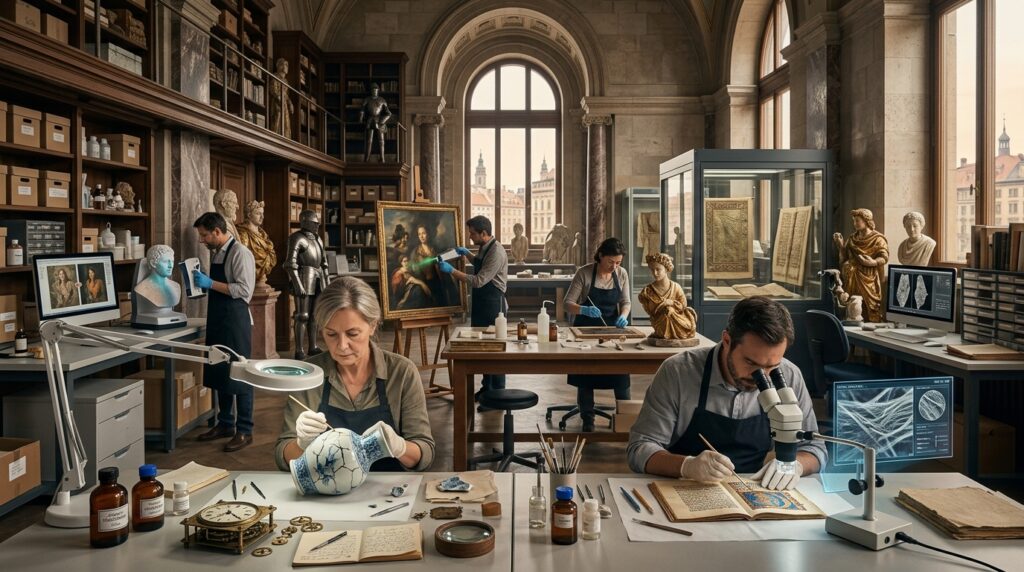
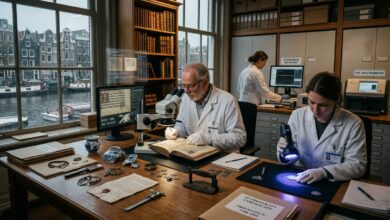
At the Inner Mongolia Museum’s “artifact hospital,” conservators use handheld X-ray fluorescence spectrometers to analyze surface deposits on gilded silver artifacts before beginning any mechanical cleaning. This allows them to understand the deposit’s composition and select appropriate removal methods .
Specialized Techniques by Material Type
Textile and Leather Restoration
Organic artifacts present unique challenges due to their sensitivity to moisture and environmental conditions. For a thousand-year-old embroidered leather bag from China’s Liao Dynasty (916-1125), conservators developed a bespoke “rehydration” regimen. Because bronze and organic materials have vastly different moisture tolerances, the team slowly reawakened leather fibers under strictly controlled temperature and humidity before attempting to detach the bronze buckle .
Low-pressure vacuum cleaners apply localized negative pressure for gentle surface dust removal. Smoothing every crease and supporting fragile sections demands extreme patience, as restoration follows no fixed timetable .
Metal Artifact Conservation
Advanced methods for metal restoration include:
- Electrolytic reduction: For iron artifacts to remove chlorides
- Animal glue peels: An established practice with new modifications for brass corrosion reduction
- Gel-based cleaning: Newly adapted gels based on Silly Putty’s chemical properties target tenacious varnish residues
Furniture and Gilded Surfaces
For antique furniture and gilded frames, modern conservation combines traditional craftsmanship with scientific methods. French gilded frames, for example, may undergo structural stabilization with low-viscosity consolidants before surface reconstruction with fine plaster and animal glue mixtures. Traditional water-gilding with high-purity gold leaf remains the standard for surface finishing .
Painting Restoration Ethics and Methods
The MIT mask method raises important ethical considerations. Any restoration should be done in consultation with conservators knowledgeable about the painting’s history and origins. The goal is not to create an entirely new work but to reveal the artist’s original intent while respecting the artifact’s age and history .
Comparison of Traditional vs. Advanced Methods
Conservation Science Education and Resources
The field of conservation science has matured significantly. The second edition of “Conservation Science: Heritage Materials” (Royal Society of Chemistry, 2021) covers analytical techniques and data processing methods that have emerged in the past decade, with case studies for each class of material from wood and stone to modern plastics .
Key principles taught in modern conservation programs include:
- Minimal intervention: Only perform necessary treatments
- Reversibility: All treatments should be undoable by future conservators
- Discernibility: Restoration work should be identifiable (though not necessarily visible)
- Documentation: Every action must be recorded
Future Directions
The integration of artificial intelligence, advanced laser systems, and nanomaterials continues to expand restoration possibilities. Researchers are exploring femtosecond laser applications for even more precise cleaning, while AI algorithms improve at predicting original colors and patterns from damaged surfaces.
The digital record-keeping aspect of advanced antique restoration methods may prove as valuable as the physical results. For the first time in conservation history, future conservators will have an extremely clear understanding of exactly what was done to an artifact and why .
Conclusion
Advanced antique restoration methods represent a convergence of art, science, and technology. From AI-generated restoration masks that can revive a painting in hours to laser systems that clean daguerreotypes without contact, these techniques honor the past while embracing the future. The core principles remain unchanged – respect for the original artifact, reversibility of treatments, and meticulous documentation – but the tools available to modern conservators have expanded dramatically. As these methods continue to develop, more damaged art will emerge from storage, allowing future generations to experience our shared cultural heritage in its restored glory.
Frequently Asked Questions (FAQs)
Q1: What is the most advanced method for painting restoration today?
A: The MIT-developed AI-generated restoration mask is currently among the most advanced. It uses artificial intelligence to analyze damage, generate color-matched fills, and print them on removable polymer films – completing in hours what traditionally took months .
Q2: Can laser cleaning damage artifacts?
A: When properly calibrated by trained conservators, laser cleaning is safe and highly precise. Different wavelengths (e.g., 248nm for daguerreotypes) are selected based on the artifact material. However, incorrect parameters can cause damage, so this work should only be performed by qualified professionals .
Q3: Are advanced restoration methods reversible?
A: Yes. A key principle of modern conservation is reversibility. The MIT mask can be dissolved with conservation-grade solutions. Laser and plasma cleaning remove only degradation layers, not original material, when properly applied.
Q4: How do conservators know what the original looked like?
A: Conservators use multiple lines of evidence: remaining original material, historical documentation, technical analysis (pigment identification, binding media analysis), and comparison with similar artifacts from the same period. AI algorithms assist by learning patterns from undamaged areas.
Q5: What is the difference between restoration and conservation?
A: Conservation focuses on stabilizing and preserving the existing material with minimal intervention. Restoration goes further, attempting to return the artifact to an earlier state by filling losses and recreating missing elements. Both follow ethical guidelines, but restoration involves more interpretation.
Q6: How can I find a qualified conservator using advanced methods?
A: Look for professionals accredited by national conservation organizations such as the American Institute for Conservation (AIC), the Institute of Conservation (ICON) in the UK, or the Restauratoren Nederland (RN) in the Netherlands. These organizations maintain directories and require continuing education.
Q7: What does CO2 snow cleaning cost?
A: Costs vary widely based on the artifact size and condition. CO2 snow requires specialized equipment and training, making it more expensive than traditional cleaning but often justified for valuable or sensitive artifacts where traditional methods would cause damage.
Q8: Are these advanced methods available for private collectors?
A: Yes, but they are typically expensive and reserved for high-value artifacts. Major museums and institutional conservators have primary access. Private collectors should contact accredited conservators who can advise on appropriate treatment options based on the artifact’s value and condition.
Image Suggestions for This Article
- MIT AI-generated restoration mask being applied to painting (alt: “AI restoration mask application for antique painting”)
- UV laser cleaning system for daguerreotype restoration (alt: “UV laser cleaning antique daguerreotype”)
- CO2 snow cleaning process on brass clock mount (alt: “CO2 snow cleaning antique brass”)
- XRF spectrometer analysis of gilded artifact (alt: “XRF analysis antique restoration”)
- Before/after comparison of laser-cleaned metal artifact (alt: “laser cleaning antique metal before after”)
- Conservator using microscope for diagnostic analysis (alt: “microscopic analysis antique restoration”)
- Comparison chart: traditional vs advanced restoration timeline (alt: “advanced restoration time comparison chart”)