Meta Description: Master old object comparison with this expert guide. Learn to distinguish antique vs vintage vs retro, compare manufacturing quality, and identify authentic artifacts in the Netherlands. Includes practical tables and FAQs.
Introduction
Walking through a Dutch antique market in Amsterdam, Delft, or Maastricht, you will encounter objects from many centuries. But how do you tell a genuine 17th-century Delftware vase from a 1970s retro reproduction? When is an item considered antique versus vintage? These distinctions matter for collectors, insurers, and anyone preserving Dutch cultural heritage.
This old object comparison guide provides systematic methods for evaluating and categorizing historical artifacts. Whether you collect paintings, furniture, ceramics, or mechanical devices, understanding comparison criteria helps you make informed decisions about authenticity, value, and preservation needs in the Netherlands‘ unique climate .
Fundamental Classifications: Antique, Vintage, and Retro
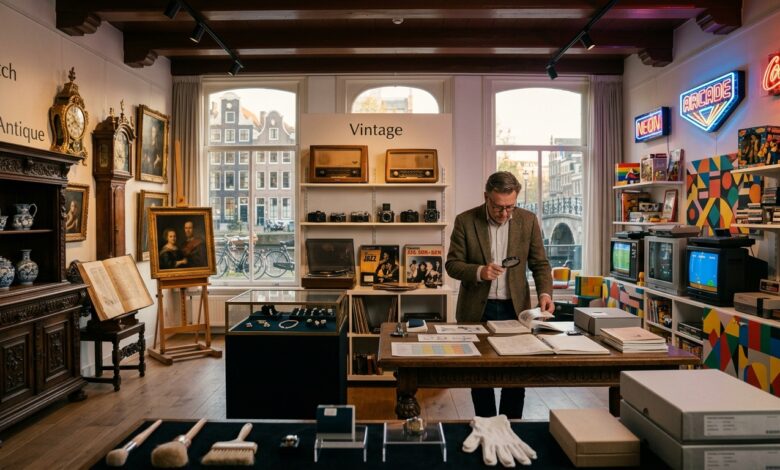
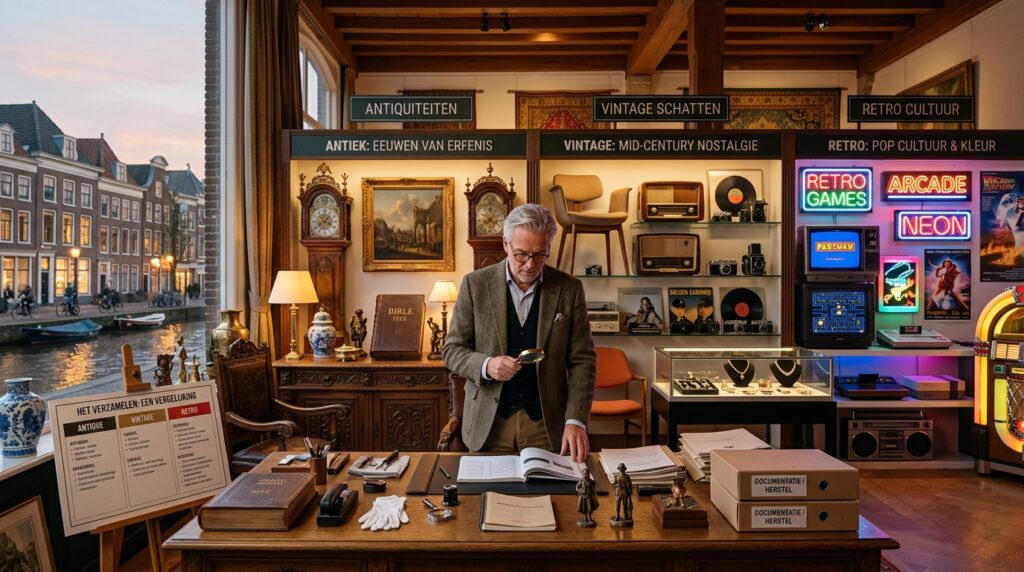
Before comparing individual objects, you must understand the three primary categories used in the Netherlands and across Europe .
| Category | Age Requirement | Key Characteristics | Value Indicator | Example (Netherlands) |
|---|---|---|---|---|
| Antique | 100+ years old | Handcrafted, period-specific materials, signs of authentic aging | High; often requires export permit under Erfgoedwet 2016 | 17th-century Delftware, Rijksmuseum-quality pieces |
| Vintage | 20-99 years old | Era-defining style, original condition, reflects period aesthetics | Moderate to high for rare pieces | 1950s Philips radios, 1960s Dutch design furniture |
| Retro | Any age (style-based) | Reproduces or imitates past styles, modern materials possible | Lower than genuine antique/vintage | Modern Delftware reproductions, neo-art deco pieces |
What Defines an Antique?
In the Netherlands, as in most of Europe, an object must be at least 100 years old to qualify as antique . The term derives from the Latin antiquus, meaning “old” or “ancient.” For example, in 2026, any item made in 1926 or earlier can be called antique.
Key distinguishing features of authentic antiques include:
- Handmade construction with visible tool marks
- Period-appropriate materials (solid wood, hand-blown glass, natural pigments)
- Authentic patina (surface wear consistent with age)
- Original hardware (hinges, locks, handles from the period)
Understanding Vintage
Vintage objects are 20 to 99 years old and capture the essence of a particular era . The word comes from French vendage (grape harvest), suggesting a “good year” or specific period of origin.
For collectors in the Netherlands, notable vintage periods include:
- 1950s-1960s: Post-war reconstruction, Philips electronics, modernist furniture
- 1970s: Dutch pop art, geometric patterns, synthetic materials
- 1980s-1990s: Early digital devices, Memphis design influence
Retro Explained
Retro refers to objects that look old but are not necessarily old. A retro item is a contemporary reproduction or style imitation . The term comes from Latin retro, meaning “backwards” or “past.”
Important distinction: A 2025 factory can produce a “retro radio” that looks like a 1950s model. It captures vintage aesthetics but lacks vintage age or authenticity.
How to Compare Old Objects: Systematic Approach
1. Age Determination Methods
| Method | Best For | Accuracy | Netherlands Availability |
|---|---|---|---|
| Provenance documentation | All objects | High (if authenticated) | Rijksbureau voor Kunsthistorische Documentatie (RKD) |
| Maker’s marks / signatures | Ceramics, silver, furniture | Moderate to high | Rijksmuseum archives |
| Material analysis (dendrochronology) | Wooden objects | High (±5 years) | University of Groningen |
| Patina examination | Metals, wood, leather | Moderate | Requires trained eye |
| Scientific dating (C14, TL) | Organic materials, ceramics | Very high | RCE (Amersfoort) |
2. Material and Construction Comparison
When comparing two similar objects, examine these attributes :
| Attribute | Antique (pre-1926) | Vintage (1926-2006) | Retro (any age) |
|---|---|---|---|
| Joinery | Dovetail, mortise-tenon, hand-cut | Machine-cut, some hand finish | Modern fasteners, glue |
| Glass | Wavy, bubbles, pontil mark | Machine-rolled, consistent thickness | Modern float glass |
| Metal components | Hand-forged, irregular screws | Machine-made, standard screws | Modern alloys, self-tapping |
| Surface finish | Hand-applied, uneven wear | Sprayed or dipped, period-appropriate | Modern synthetic finishes |
3. Manufacturing Quality Comparison
Modern scientific methods allow objective comparison of manufacturing quality across objects. A 2025 study from npj Heritage Science demonstrated that 3D scanning can distinguish between ancient handcrafted vessels and modern machine-made reproductions with high accuracy .
The study developed a quality metric based on:
- Circularity: How perfectly round a cross-section is
- Concentricity: How centered the object’s symmetry axis is
- Surface consistency: Uniformity of finish
Practical application: If comparing two ceramic vases—one potentially 17th-century Dutch, one modern reproduction—measure the rim circularity. Ancient hand-thrown pottery shows subtle irregularities (circularity deviation 0.5-2mm), while machine-made pieces achieve near-perfect consistency (deviation <0.1mm) .
Object Type-Specific Comparison Guide
Ceramics (Delftware, Pottery, Porcelain)
| Feature | Genuine Antique (pre-1900) | Vintage (1900-1990) | Retro/Reproduction |
|---|---|---|---|
| Foot rim | Rough, unglazed | Smooth, partially glazed | Perfectly smooth, fully glazed |
| Glaze crazing | Even, fine network | Variable, often crackle effect | Artificial, or none |
| Decor method | Hand-painted (brush strokes visible) | Decal transfer or spray | Digital print or decal |
| Markings | Hand-stamped or painted | Printed mark | Modern logo or “reproduction” stamp |
Furniture
| Feature | Antique | Vintage | Retro |
|---|---|---|---|
| Wood type | Solid period woods (oak, walnut, mahogany) | Solid wood or quality veneers | Particle board, MDF, laminates |
| Wear pattern | Uneven, concentrated on high-use areas | Even, may be artificially distressed | None or uniform |
| Hardware screws | Hand-cut threads, irregular slots | Machine-cut, standard Phillips/slotted | Modern cross-head, power-driven |
Paintings and Prints
For artwork comparison, examine :
| Aspect | Old Master (pre-1900) | 20th Century | Modern Print/Reproduction |
|---|---|---|---|
| Canvas | Hand-woven, irregular weave | Machine-woven, consistent | Textured paper or synthetic |
| Frame | Period-appropriate wood, original gilding | Later frame, refinished | Modern plastic/resin |
| Signature | Hand-signed, consistent with period | Signed, often dated | Printed signature or stamp |
Mechanical Devices and Instruments
The Netherlands has rich collections of old mechanical devices—clocks, barometers, early radios. When comparing these :
| Component | Authentic Pre-1950 | Vintage 1950-1990 | Reproduction |
|---|---|---|---|
| Gears/mechanism | Brass with hand-cut teeth, visible tool marks | Stamped metal, uniform | Plastic or laser-cut metal |
| Wiring (electrical) | Cloth-covered rubber, darkened | Plastic insulation, age-stiffened | Modern PVC, flexible |
| Screws/bolts | Whitworth or BA thread standards | Metric or US standard | Modern metric, zinc-plated |
| Serial numbers | Hand-stamped, irregular spacing | Machine-engraved, consistent | Laser-etched, perfect |
Common Comparison Mistakes to Avoid
- Confusing patina with dirt: Genuine age patina is bonded to the surface; dirt wipes off. Never clean an antique aggressively before evaluation.
- Over-relying on signatures: Signatures can be forged. Compare the entire object—construction, materials, wear patterns—not just the mark .
- Ignoring Dutch climate effects: The Netherlands‘ high humidity (81% average RH) accelerates corrosion and mold. An object with minimal wear may actually be younger than one showing climate damage.
- Assuming all old objects are valuable: Age alone does not determine value. Rarity, condition, provenance, and craftsmanship matter equally.
Legal Considerations in the Netherlands
Under the Dutch Cultural Heritage Act (Erfgoedwet 2016), certain old objects require special handling:
| Object Category | Restriction | Relevant Authority |
|---|---|---|
| National significance artifacts | Registration required | Rijksdienst voor het Cultureel Erfgoed (RCE) |
| Export of antiques over 100 years | Permit required | RCE + Ministry of Education, Culture and Science |
| Archaeological finds (any age) | Must be reported | Municipality or RCE |
| Looted or illegally excavated items | Cannot be bought/sold | Nationaal Expertisecentrum (NEC) |
FAQ: Old Object Comparison
Q1: How accurate are online “antique age” calculators?
Not reliable. Age determination requires physical examination. Professional appraisal in the Netherlands costs €95-175 per hour.
Q2: Can an object be both vintage and retro?
No. Vintage refers to actual age (20-99 years). Retro refers to style only—a retro object can be brand new .
Q3: What is the best way to compare two similar old objects?
Place them side by side under consistent lighting. Use a 10x loupe to examine surface details. Photograph both with a scale reference. Compare material, construction, wear, and markings systematically .
Q4: How does Dutch humidity affect old object comparison?
High humidity causes wood swelling, metal corrosion, and paper mold. An object stored in a dry Amsterdam attic may appear younger than one kept in a canal house basement, even if both are the same age. Always consider storage history .
Q5: Where in the Netherlands can I get expert comparison services?
- Rijksmuseum (Amsterdam) – conservation department consultations
- Restauratoren Nederland (RN) – directory of certified conservators
- Venduehuis der Notarissen (The Hague) – auction house with authentication services
- University of Amsterdam – Heritage Studies department
Q6: How do I identify fake age signs on a retro piece?
Look for consistent, uniform wear (real wear is uneven). Check corners and crevices—faked age often misses tight spaces. Burn marks or chemical distress smells artificial. Authentic patina has no odor.
Quick Reference: Comparison Checklist
For any old object you evaluate in the Netherlands, complete this checklist:
- Measure age (100+ years = antique, 20-99 = vintage, under 20 = contemporary)
- Examine material type (period-appropriate?)
- Check construction method (hand vs. machine)
- Inspect wear pattern (natural vs. artificial)
- Verify signatures/marks against reference databases (RKD, Rijksmuseum)
- Document with photographs (include scale and lighting notes)
- Consider storage history (Dutch climate effects)
- Consult a certified conservator for high-value pieces
Conclusion
Mastering old object comparison requires practice, patience, and systematic evaluation. Whether you collect Dutch Golden Age paintings, 1950s Philips radios, or mid-century Delftware, understanding the differences between antique, vintage, and retro categories protects your investment and preserves cultural heritage.
The Netherlands offers exceptional resources for collectors—world-class museums, active conservator networks, and strong legal protections for heritage objects. Use this guide as your reference, but always seek professional authentication for high-value acquisitions. Remember: age tells part of the story, but construction, materials, and provenance complete the narrative.
Image Suggestions for This Article
- Side-by-side comparison of antique Delftware vase vs. modern retro reproduction (alt: “old object comparison guide antique vs retro delftware netherlands”)
- Close-up showing hand-cut dovetail joints vs. machine-cut joints (alt: “furniture joinery comparison old object guide”)
- Diagram of ceramic foot rim differences across periods (alt: “ceramic foot rim comparison antique vintage retro”)
- Photograph of Dutch hygrothermograph for climate assessment (alt: “netherlands humidity effects on old objects comparison”)
- 3D scan visualization showing circularity measurement (alt: “3d scan quality comparison ancient vs modern vessel manufacturing”)