The Complete History of Rare Collectibles Explained: From Cabinets of Curiosity to Million-Dollar Treasures
Part 1: The Ancient Origins of Collecting
The desire to collect rare and valuable objects is not a modern phenomenon. Archaeological evidence suggests that humans have been gathering and preserving special items for thousands of years.
Egyptian and Classical Antiquity
The ancient Egyptians placed immense value on jewelry, amulets, furniture, and funerary objects, often burying them with the deceased as part of elaborate burial customs . These items were believed to hold spiritual significance and were treasured both in life and death. Tombs such as that of Tutankhamun reveal the extraordinary lengths to which ancient collectors—in this case, a Pharaoh preparing for the afterlife—would go to assemble treasured possessions.
The Greeks and Romans took collecting in a new direction. Wealthy citizens and rulers amassed sculptures, coins, pottery, and other artifacts, often as a display of status and power . For them, collecting was not merely a hobby but a means of preserving culture and history. Temples and public spaces were adorned with these objects, reinforcing their importance in society. Roman patricians, in particular, developed a passion for Greek art, creating a vibrant market for antiquities that foreshadowed modern collecting practices .
Medieval Religious Collections
During the medieval period in Europe, religious institutions became the primary custodians of valuable objects. Monasteries housed beautifully illuminated manuscripts, gold-plated chalices, and rare religious texts, meticulously preserved for future generations . Nobility followed suit, with royal families displaying tapestries, ornate furniture, and artworks in their castles and estates. These collections served both devotional and political purposes, demonstrating the wealth and piety of their owners.
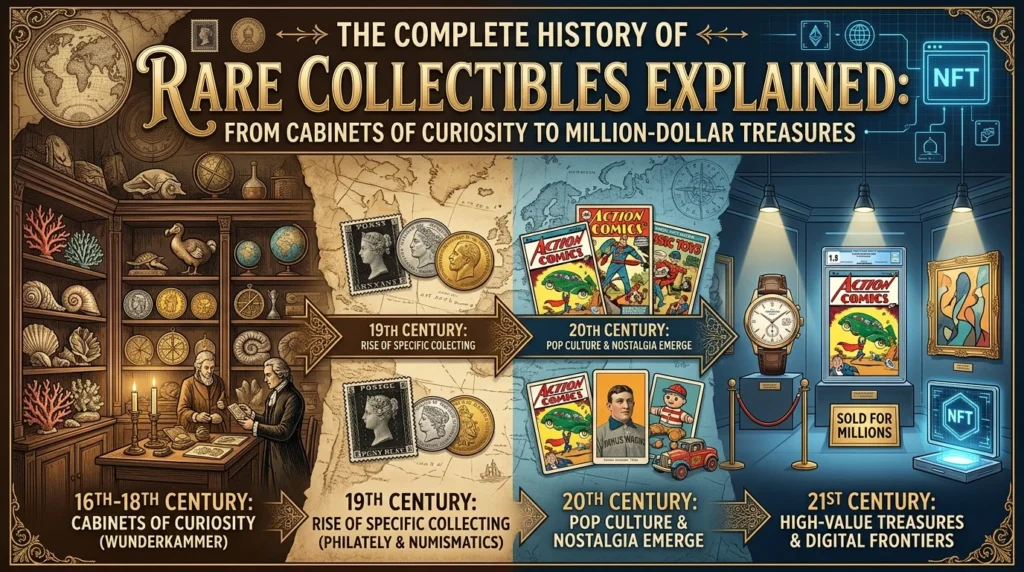
Part 2: The Renaissance and the Birth of the Wunderkammer
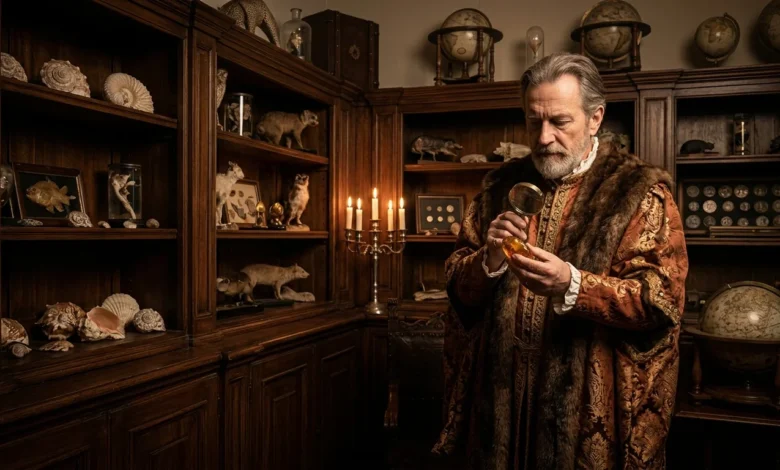
The most significant development in the history of collecting occurred during the Renaissance (14th–17th century). A renewed interest in classical art and history, combined with expanding global exploration, gave birth to the “cabinet of curiosities” or Wunderkammer—literally “wonder room” .
What Were Cabinets of Curiosities?
Cabinets of curiosities were rooms or galleries in which objects and works of art considered rare, innovative, and singular were brought together . Known as “Cabinet de curiosités” in French, “Kunst- oder Wunderkammer” in German, or “studiolo” in Italian, these collections represented a continuation of medieval encyclopedism but with a distinctly Renaissance flavor—stemming from renewed elite interest in science and antiquities fueled by expeditions around the world .
These collections were organized around three principal categories :
| Category | Description | Examples |
|---|---|---|
| Naturalia | Objects found in nature | Exotic shells, taxidermy animals, fossils, “unicorn horns” (narwhal tusks), unusual stones |
| Artificialia | Human creations or nature modified by man | Sculptures, paintings, intricate metalwork, ethnographic objects |
| Scientifica | Technical or scientific instruments | Astronomical apparatus, clocks, automata, mechanical devices |
Famous examples of cabinets of curiosities existed throughout Europe: the Este family in Ferrara, the Medici family in Florence, Francis I in Fontainebleau, Ferdinand II in Innsbruck, and Augustus the Strong in Dresden .
Rudolf II in Prague: The Collector Emperor
Perhaps the most famous cabinet of curiosities belonged to Rudolf II (1552–1612), sovereign of the Holy Roman Empire and King of Bohemia. When he chose Prague as his residence in 1583, he transformed it into a cultural and artistic capital, attracting artists from across Europe .
Rudolf’s collection was legendary. Inventories include objects made from elements found in nature, taxidermy items, and even a purported unicorn horn . Goldsmiths created extraordinary pieces from rhinoceros horns, ivory, tortoise shells, seashells, coconuts, and bezoar stones. The collection also served as a laboratory for experimentation, with astronomers like Johannes Kepler working at Rudolf’s court, attempting to apply concepts of polyhedral harmony to the solar system .
Crucially, these cabinets of curiosities were not merely accumulations of treasures. They served a profound political purpose: representing monarchical power, testifying to knowledge, prestige, and sphere of influence . A ruler who possessed rare objects from distant lands demonstrated connections, resources, and intellectual sophistication that reinforced their right to rule.
The Dark Side of Curiosity Cabinets
It is impossible to discuss cabinets of curiosities without acknowledging their connection to European colonialism. Weapons, basketry, musical instruments, and sculptures were brought back from Africa, the Americas, and Asia . While gold was often melted down, ivory remains one of the most obvious examples of these collections linked to colonization. Exoticism was not limited to the cabinets themselves but persisted through subsequent centuries, with explorers, scientists, and even universal exhibitions contributing to a dehumanized vision of non-European peoples and cultures .
Part 3: The Golden Age of Collecting (18th–19th Centuries)
The 1700s and 1800s marked a dramatic expansion of antique collecting, particularly in Europe. Several factors converged to create what many consider the golden age of collecting.
Archaeology and the Grand Tour
As archaeology developed as a formal discipline, explorers and scholars uncovered treasures from lost civilizations, sparking widespread interest. The discovery of Pompeii in 1748 fueled enthusiasm for classical antiquities, and wealthy collectors eagerly acquired ancient Roman and Greek artifacts .
The Grand Tour became an essential rite of passage for young European aristocrats. Traveling through Italy, Greece, and France, they would bring back antique treasures, sculptures, and paintings . This practice spread collecting beyond royal courts into the broader aristocracy.
The Victorian Era: Democratization of Collecting
The Victorian era (1837–1901) represented a genuine golden age for collectors. The British Empire had expanded across the globe, allowing collectors to acquire objects ranging from Chinese porcelain to Egyptian mummies—though it must be noted that much of this acquisition occurred through colonial extraction rather than ethical trade .
This period saw the establishment of major museums, including the British Museum, which helped shape public interest in antiques. Middle-class families began decorating their homes with antique furniture and decorative objects, making collecting more accessible beyond the aristocracy . During this period, furniture, paintings, and decorative arts became highly sought after, with collectors prizing items that showed intricate craftsmanship and historical significance.
Part 4: The Rise of Specialized Collecting (19th–20th Centuries)
The 19th century witnessed the emergence of specialized collecting categories, with numismatics (coin collecting) and philately (stamp collecting) becoming particularly significant.
The Development of Numismatics
The web of private coin collectors increased dramatically during the 19th century, with handbooks for novices beginning to appear . Numismatic societies formed throughout Britain, Europe, and the United States, with membership open to all ranks of the general public. Periodicals about coin collecting emerged, and the growing appetite of new advocates led to a prosperous industry .
The scope of collecting broadened from ancient coins to coins of the world, and the activity became a popular hobby. Professional numismatists (coin dealers) became more tightly knit, and trade associations were established .
The 20th Century: Professionalization and Investment
The 20th century saw an even greater widening of the coin-collecting fraternity, with the establishment of coin shows, numismatic conventions, international conferences, academic symposia, and a proliferation of local clubs .
Significantly, the development of the market led to the promotion of coins as a vehicle for investment. Investors assembled private portfolios of collectible coins, with at least two major funds for investment in ancient coins traded on the New York Stock Exchange in the late 1980s and early 1990s .
The advent of the Internet in the late 20th century spawned an entirely new culture of collectors. Widespread exposure to a remarkably large audience created more new collectors than the hobby had seen in decades, though this also brought challenges related to seller integrity and authentication in online marketplaces .
Part 5: Famous Examples of Extraordinary Rare Collectibles
Understanding the history of rare collectibles is best achieved through examining specific objects that have captured the world’s imagination.
The British Guiana One-Cent Magenta (Stamp)
No postage stamp is rarer than the sole-surviving example of the British Guiana One-Cent Magenta . In January 1856, British Guiana issued a small number of one- and four-cent stamps for provisional use while awaiting a shipment from England. The one-cent stamp on display at the Smithsonian’s National Postal Museum is the only one of its kind in the world .
Its history reads like a novel. In 1873, a twelve-year-old Scottish boy named Louis Vernon Vaughn discovered the stamp among some old papers at his uncle’s home in British Guiana. Unhappy with its appearance, he sold it for six shillings to buy prettier foreign stamps . The stamp passed through the hands of wealthy collectors, disappeared for decades behind bank vault bars, and in 2014 sold to shoe designer Stuart Weitzman. Having recently sold for almost $10 million, by sheer size and weight, it may be the most valuable single object in the world today .
The Traveller Collection (Coins)
A remarkable coin collection, most of which remained buried underground for over five decades, is expected to surpass $100 million at auction . Named the Traveller Collection, this extraordinary assemblage began when an anonymous collector started acquiring gold coins after the Wall Street Crash of 1929. Over time, he developed “a taste for coins with great historical interest, beauty and rarity” and eventually amassed approximately 15,000 coins .
Sensing the impending danger of Nazi domination of Europe, the collector carefully packed the coins into cigar boxes, placed them inside aluminum containers, and buried them underground, where they remained undisturbed for five decades . When eventually retrieved by his heirs, the coins were placed in a bank vault before being presented to auction.
Among the collection’s standout pieces is a 100 ducat gold coin of Ferdinand III of Habsburg, minted in 1629. Weighing 348.5 grams of fine gold—approximately the weight of a tin of soup—it ranks among the largest European gold coins ever minted . One of only three of its kind known in the world, it sold for approximately $2.25 million, becoming the most expensive European coin ever sold .
The Spanish Centen (Coin)
A large gold coin minted in 1609 for Spain’s King Philip III broke records to become the most valuable European coin at auction, selling for 2,817,500 Swiss francs ($3.49 million) . The Centen, or 100 escudos, was minted in Segovia from gold brought by conquistadores from the Americas. Made as a show of regal wealth and power, it represents the largest denomination in modern European history . Lost for centuries, it turned up in the United States around 1950 and has since been treasured by a succession of private collectors.
Part 6: What Makes a Collectible Rare and Valuable?
Understanding why certain objects become extraordinarily valuable requires examining multiple factors that professional appraisers and auction houses consider.
Key Value Determinants
| Factor | Explanation | Example |
|---|---|---|
| Rarity | Fewer surviving examples equals higher value | British Guiana stamp (1 known example) |
| Condition | State of preservation significantly impacts price | “Mint state” coins vs. worn examples |
| Provenance | Known ownership history, especially famous previous owners | Items owned by royalty or historical figures |
| Historical Significance | Association with important events or periods | Coins from WWII-era hoards |
| Demand | Collector interest in specific categories | Current market trends |
| Authenticity | Verified genuine vs. reproduction or forgery | Professional certification matters |
The Problem of Forgery
With advances in modern technology, the issue of forgery has become increasingly important to collectors. While counterfeit coins existed in antiquity (often for profit or out of necessity during coin shortages), modern forgery specifically targets the collector market where value as legal tender is irrelevant . Fortunately, there are as many tools at the disposal of the collector as there are available to the forger, and over time the vast majority of forgeries are detected .
Part 7: The Modern Era of Collecting
Today, antique collecting can be both a passion and a potential financial investment. The 20th century saw the rise of a structured antique trade industry, with auction houses like Sotheby’s and Christie’s playing crucial roles in selling high-value antiques worldwide .
The Arts and Crafts movement, along with the rise of interior design, encouraged appreciation for handcrafted antique furniture as a reaction against industrial mass production. During the mid-20th century, styles such as Art Deco and Art Nouveau became highly desirable .
The post-WWII era saw a shift toward everyday objects from the past. Mid-century modern furniture, vintage advertising signs, and retro kitchenware became collectible. The 1960s and 1970s also saw a rise in flea markets and antique fairs, making collecting more accessible to the general public .
Part 8: From Cabinets to Museums
The evolution from private cabinets of curiosities to public museums represents one of the most significant transformations in the history of collecting.
The first museums opened in Basel in 1661 and Oxford in 1681 (the Ashmolean Museum) . However, it was during the French Revolution that collections of the nobility and clergy were requisitioned, divided up, and brought together by category in museums. Natural history museums were created in Paris (1793), Berlin (1810), and London (1881) .
The aim shifted dramatically: no longer seeking “extraordinary” specimens and curiosities, museums launched exhaustive inventories of the world’s diversity in the name of universality . Today, the objects from historical cabinets of curiosities form part of museum collections worldwide, serving as the foundation of our shared cultural heritage.
Frequently Asked Questions (FAQ)
Q1: What is the oldest known collectible in history?
A: Archaeological evidence suggests that humans collected objects as early as the Paleolithic era. However, the first organized, documented collecting for non-utilitarian purposes emerged in ancient Egypt and Mesopotamia, where valuable objects were buried with royalty as grave goods dating back over 5,000 years .
Q2: What is a Wunderkammer or cabinet of curiosities?
A: A Wunderkammer (German for “wonder room”) was a Renaissance-era collection of rare and extraordinary objects, combining natural specimens (naturalia), human creations (artificialia), and scientific instruments (scientifica). These collections were precursors to modern museums and served as demonstrations of their owners’ wealth, knowledge, and global connections .
Q3: What makes a coin or stamp rare enough to be worth millions?
A: Extreme scarcity (few surviving examples), exceptional condition, historical significance, and documented provenance all contribute. The British Guiana stamp is valuable because only one exists. The 1629 Ferdinand III ducat is valuable because only three are known, and its large gold content and royal commission add historical importance .
Q4: How can I tell if a collectible I own is historically significant?
A: Research its provenance (ownership history), look for maker’s marks or hallmarks, examine construction techniques that indicate age, and compare with verified examples in museum collections or auction records. Professional appraisal is recommended for items of potential value.
Q5: When did coin collecting become a popular hobby?
A: While wealthy individuals collected coins since ancient Rome, coin collecting became a widespread public hobby during the 19th century, with the formation of numismatic societies, publication of guidebooks, and emergence of coin shows and conventions .
Q6: How did colonialism affect antique collecting?
A: Colonial expansion provided European collectors with access to artifacts, natural specimens, and cultural objects from Africa, Asia, and the Americas. While this enriched European collections, it often involved unethical acquisition and contributed to the dehumanization of colonized peoples in European imagination .
Q7: What is the most valuable rare collectible ever sold?
A: While values fluctuate, the British Guiana One-Cent Magenta stamp has sold for nearly $10 million. Certain rare paintings, classic cars, and historical manuscripts have sold for significantly more, but for its size and weight, the stamp is considered among the most valuable objects ever traded .
Q8: Are rare collectibles a good financial investment?
A: While some collectibles appreciate significantly, experts caution that collecting should primarily be pursued for passion rather than pure investment. Markets fluctuate, authenticity requires expertise, and transaction costs are high. However, major auction houses have seen sustained growth in the rare coin and antique markets .
rare collectibles history antique collecting origins cabinets of curiosities Wunderkammer most valuable collectibles rare coin history British Guiana stamp Traveller Collection numismatics history philately