The Ultimate Guide to Forgotten Historical Objects: Lost Treasures, Rediscovered Relics, and the Secrets They Hold
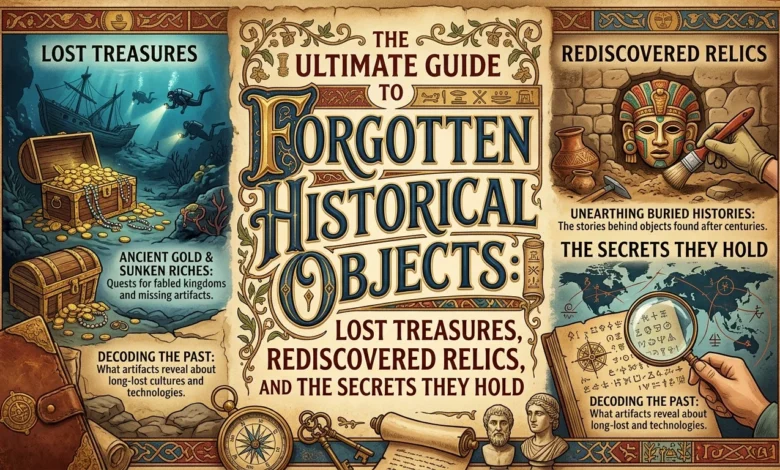
This comprehensive guide explores the most remarkable forgotten objects recently rediscovered, from golden helmets stolen in museum heists to medieval silver hoards unearthed by worm diggers. It also explains how experts uncover the secrets of these objects using modern conservation techniques and why some artifacts remain forgotten by design.
Part 1: What Makes an Object “Forgotten”?
An object becomes “forgotten” in several distinct ways, each telling a different kind of story about human civilization, catastrophe, and memory.
| Type of Forgotten Object | How It Happens | Examples |
|---|---|---|
| Hidden for Safekeeping | Owners buried valuables during conflict, never returned | Stockholm silver hoard, buried during dynastic strife |
| Lost in Disaster | Shipwrecks, fires, or natural disasters buried objects | La Pérouse expedition shipwrecks (1788) |
| Deliberately Concealed | Ritual hiding, folk magic, or secret deposits | Concealed shoes in chimneys and walls |
| Forgotten in Storage | Museum objects mislabeled or ignored for decades | Viking brooch hidden inside organic lump for 100+ years |
| Stolen and Recovered | Artifacts looted from museums or archaeological sites | Coţofeneşti Helmet (stolen 2025, recovered 2026) |
As one conservator noted, forgetting is often the first step toward rediscovery: “Things aren’t often ‘discovered’ in storage. What happens is someone with advanced knowledge is able to spend time with material and see things anew.”
Part 2: The Coţofeneşti Helmet – A Golden Treasure Lost and Found
One of the most dramatic stories of a forgotten—and nearly lost forever—historical object involves the Coţofeneşti Helmet, a 2,500-year-old golden masterpiece from ancient Dacia. Discovered in the 1920s in Prahova County, Romania, this helmet has become one of the most representative pieces of Romania’s historical treasure.
What Makes This Helmet Extraordinary
The helmet is made of solid gold and dates to the 4th century B.C. It is decorated with intricate motifs, including a pair of apotropaic (evil-averting) eyes on the front and scenes of sacrifice on the cheek guards—the side pieces that cover the cheeks. Experts consider it a unique artifact associated with the Getic elite and a testament to the cultural ties between the Carpathian-Danube region and the Greek or Scythian world.
The Theft That Shocked the Art World
In January 2025, the Coţofeneşti Helmet and three golden Dacian bracelets were stolen from the Drents Museum in Assen, the Netherlands, where they were on display as part of the exhibition “Dacia – The Kingdom of Gold and Silver.” The thieves used explosives to force their way into the museum, then smashed the display cases and made off with the treasures.
For 14 months, the helmet’s fate was unknown. There were fears it may have been melted down because its fame and distinctive appearance made it virtually unsellable on the black market.
The Recovery
In early April 2026, the helmet and two of the three stolen bracelets were recovered. The artifacts arrived at Bucharest Henri Coanda International Airport under guard and were transported to the National History Museum, where they were displayed in a glass cabinet flanked by masked, armed guards.
Cornel Constantin Ilie, the museum’s interim director, described their return: “These artifacts have been returned not as simple patrimony items, but as relics of our historical memory, as the legacy of a civilization that continues to define us. For months, we have lived with the fear that part of our past could be lost forever.”
The helmet was slightly dented during its disappearance, but the recovered bracelets were in perfect condition. The whereabouts of the third golden bracelet remains unknown, and the search continues.
| Artifact | Age | Material | Current Status |
|---|---|---|---|
| Coţofeneşti Helmet | 4th century B.C. (approx. 2,500 years old) | Gold | Recovered April 2026, slightly dented |
| Dacian Bracelets (3 total) | Dacia civilization | Gold | Two recovered, one still missing |
Part 3: The Stockholm Silver Hoard – A Worm Digger’s Accidental Discovery
Not all forgotten objects are stolen from museums. Some have been waiting in the ground for centuries, hidden by their original owners who never returned to retrieve them.
In October 2025, an unidentified man digging for worms beside his summer house in a Stockholm suburb struck something unexpected: a corroded copper cauldron whose walls had partly disintegrated, sending thousands of silver coins mixed with beads, pendants, and rings spilling into the soil.
The Hoard by the Numbers
| Measurement | Detail |
|---|---|
| Total weight | Approximately 6 kilograms (13+ pounds) |
| Estimated coin count | Up to 20,000 silver coins |
| Period | Late 12th century (early medieval) |
| Find date | October 2025 |
| Location | Stockholm suburb, Sweden |
What the Coins Reveal
Preliminary numismatic study placed most of the coins in the late 12th century. Several carry the inscription “KANUTUS,” the Latinized name of King Knut Eriksson, who ruled Sweden from 1173 to about 1195 and reintroduced royal coinage after more than a century of absence. Others are “bishop coins” showing a prelate holding a crosier—currency struck by powerful clergy, indicating a competitive minting economy less than a century before Stockholm’s official founding in 1252.
Why Was It Buried?
Researchers believe the cauldron was concealed during a turbulent period marked by military campaigns in Finland and internal dynastic strife. “It was a difficult time,” said Sofia Andersson, an antiquarian with the Stockholm County Administrative Board. Lin Annerbäck, director of Stockholm’s Medieval Museum, explained that affluent families often hid portable wealth “to keep it in the family.”
The Contents
Alongside the coins lie silver rings sized for adults, necklace pendants, and strings of glass or rock-crystal beads, hinting that a single prosperous household buried both cash and personal ornaments for safekeeping. Annerbäck noted that medieval artifacts “have rarely been discovered in Stockholm,” making this find “very extraordinary.”
Part 4: Shipwreck Objects – Forgotten Under the Sea
Shipwrecks preserve objects in unique ways, creating time capsules that land-based archaeology rarely equals. The 1788 wreck of the French ships Boussole and Astrolabe, led by explorer Jean-François de Galup, comte de La Pérouse, offers a powerful example.
The La Pérouse Expedition
The expedition was commissioned by King Louis XVI and intended to rival those of British explorer Captain James Cook. La Pérouse traveled with experts in botany, geology, ornithology, astronomy, and other disciplines. But the expedition disappeared in the South Pacific, becoming one of the most widely publicized disasters in French maritime history.
More than two centuries later, contemporary explorers used cutting-edge archaeology technology to collect nearly 5,000 objects from the wreckage during eight expeditions between 1996 and 2008. Many of the recovered objects had become “agglomerations,” accumulating oceanic sedimentation and transforming into new configurations of nature and culture, past and present.
The Deeper Story These Forgotten Objects Tell
Art historian Kelly Presutti, writing in “Foul Histories and Forgotten Objects: French Entanglement in the South Pacific,” argues that shipwreck objects change how we read history. “Submerged artifacts react with salt water and mineral particles, both decomposing and accumulating mass, until they are so encrusted in oceanic sediment that they become what I call ‘curious, indissociable configurations of nature and culture, past and present.’ Their forms are the work of both humans and the sea, and they speak to both the time of their making and the time spent underwater.”
These agglomerated objects tell a more complicated story of an object and its environment than pieces of art in perfect condition. They reveal moments of weakness, failure, and defeat—the forgotten undersides of imperial ambition.
Part 5: How Forgotten Objects Are Rediscovered and Restored
Forgotten objects do not simply reappear. They are found through a combination of luck, technology, and painstaking conservation work.
The Conservation Laboratory’s Role
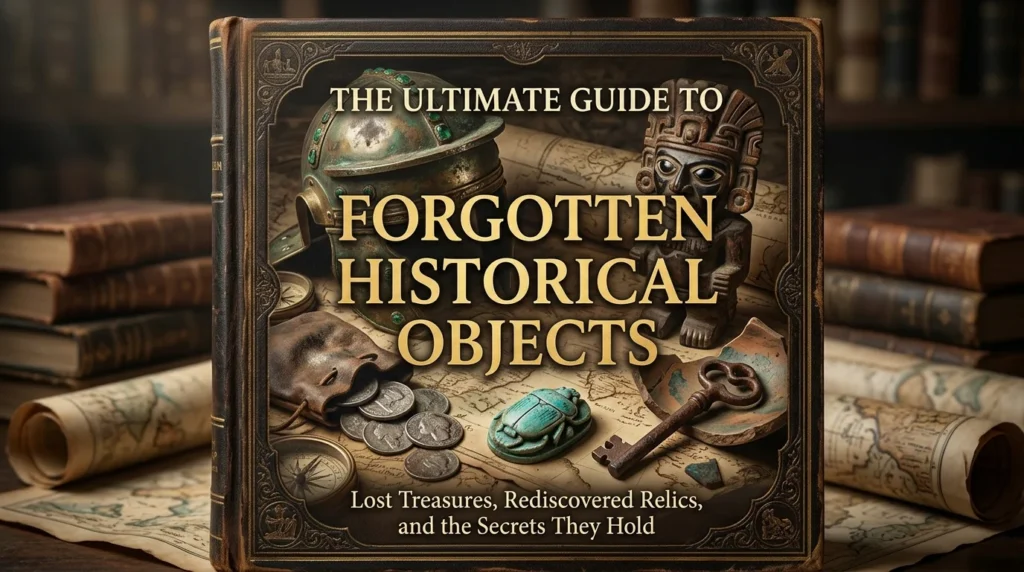
At the Vaud Cantonal Museum of Archaeology and History in Lausanne, Switzerland, conservator David Cuendet works with forgotten objects daily. He recently restored a 2,000-year-old Roman key discovered at an archaeological training dig.
The restoration process involved:
| Step | Method | Purpose |
|---|---|---|
| Sandblasting | Glass pellets at precise pressure | Remove corrosion while preserving original metal |
| Radiography | X-ray imaging | Identify object without cleaning first |
| Chemical stabilization | Sodium sulphate and sodium hydroxide baths | Stop ongoing decay processes |
“This key is about 2,000 years old, that’s the Roman period,” Cuendet explained, “and it was found in Vidy-Boulodrome, a dig used to train archaeology students from the University of Lausanne.”
The Philosophy of Modern Conservation
Cuendet notes that the field has changed dramatically over the past 30 years: “Over the years, we’ve become increasingly less interventionist.” The aim of restoration is no longer to revert objects to their original state but to help place them in their original setting. “This is because objects have no meaning outside of their context.”
A broken vase whose function is manifest won’t be rebuilt at all cost, and where it is, the repair will remain clearly visible. This approach preserves the object’s history—including its damage—as part of its story.
Technology Aiding Rediscovery
Modern technology has revolutionized how forgotten objects are identified:
- Tomography (CT scanning): Identifies material composition and reveals organic remains hidden inside corrosion. This technique identified organic remains in the rust of three ancient La Tène swords (5th–3rd century B.C.) found during digs in 2021–2022.
- Radiography: Allows conservators to determine whether funeral urns contain artifacts of interest, such as bracelets, without disturbing the objects.
Part 6: Newly Discovered Forgotten Objects from Ancient Troy
Even the most excavated sites in the world still hold forgotten objects. In October 2025, archaeologists working at Hisarlik—ancient Troy—uncovered three rare objects dated to approximately 2500 B.C.
The Troy Discoveries
| Object | Origin | Rarity |
|---|---|---|
| Gold brooch (ring brooch) | Made locally in Troy | One of only three known in the world |
| Jade piece | Likely imported from China or Afghanistan | Evidence of long-distance trade networks |
| Bronze pin | Local manufacture | Well-preserved example of Bronze Age craftsmanship |
The objects were discovered in front of a structure called the “6M Palace,” according to archaeologist Reyhan Körpe of Çanakkale Onsekiz Mart University. Culture and Tourism Minister Mehmet Nuri Ersoy announced that the well-preserved ring brooch is one of only three known in the world.
The luxurious items will be displayed at the Troy Museum, adding new chapters to the story of a city long thought to have given up all its secrets.
Part 7: Lost Objects We May Never Find
Not all forgotten historical objects are eventually recovered. Some are lost in ways that make rediscovery impossible—or nearly so.
The Problem of Medieval Loss
The book “Lost Artefacts from Medieval England and France” examines the frustration that scholars face when trying to piece together a picture of the past from a handful of fragments. The “material turn” has put art, architecture, and other artifacts at the forefront of historical studies, but “the loss of so much of the physical remnants of the Middle Ages continues to thwart our understanding of the period, and much of the knowledge we often take for granted is based on a series of arbitrary survivals.”
The twelve essays in this volume draw on chronicles, inventories, poems, and riddles to explore how textual records—when combined with archaeological and art-historical evidence—can expand our awareness of artistic and cultural environments that no longer exist in physical form.
Objects Too Fragile to Move
Sometimes objects are not truly forgotten but are deliberately kept from public view because they are too fragile to survive travel or even display. Cuendet recalls a famous example: the gold bust of Marcus Aurelius, the jewel in the crown of Vaud’s archaeological heritage. When it was loaned to the Getty collection, “both the directors of the Roman Museum of Avenches and of the Vaud Cantonal Museum of Archaeology and History travelled to the United States by plane with the case containing the bust” to ensure its security.
Other objects are simply too fragile to move at all. “Sometimes, we simply have to refuse any movement, for example, when an object is too fragile,” Cuendet explained.
The Eventual Fate of All Objects
Cuendet offers a philosophical perspective: “In any case, at some point, every object meets its destiny to be destroyed. Conservator-restorers may indeed slow down the process, but cannot avoid it, because it’s the way of things.” The aim of the job, therefore, is “knowing where we’re coming from to know where we’re going to.”
Part 8: The 100-Year-Old Viking Brooch Hidden in Plain Sight
Not all forgotten objects are buried underground. Some hide in museum storage for over a century, waiting for the right expert to recognize them.
In 1891, the British Museum acquired what appeared to be a mysterious lump of organic material from a Viking grave in Norway. For over 100 years, it sat in storage, assumed to be the remains of a wooden box. Then a glint of something shiny caught a curator’s eye. An X-ray scan revealed a staggering discovery: the lump contained an ornate gilded Celtic brooch created in Ireland or Scotland in the 8th or 9th century.
The brooch had been looted by Vikings during a raid, taken home to Norway, and buried with a high-status woman. It took over a century for this secret to be discovered.
This story illustrates a crucial point about forgotten objects: they are often not lost at all. They are simply unrecognized, sitting in plain sight within museum collections, waiting for advanced knowledge to see them anew.
Part 9: The Ethics of Forgotten Objects
When forgotten objects are rediscovered, difficult ethical questions arise.
Who Owns the Past?
The Stockholm silver hoard was found on private property by a man digging for worms. Swedish law requires anyone who discovers buried antiquities to notify the state so experts can assess the objects and determine compensation. Although Swedish law guarantees remuneration for surrendered precious-metal objects, officials have not yet announced an amount. The treasure is expected to enter a public collection, most likely the Medieval Museum in Stockholm.
Looted and Recovered
The Coţofeneşti Helmet case raises different questions. The helmet was legally loaned to a Dutch museum when it was stolen. Its recovery required 14 months of investigation, diplomatic negotiations, and international police cooperation. The helmet’s “forgotten” status was not accidental—it was criminal.
The Colonial Legacy
Many forgotten objects in Western museums were acquired during periods of European colonialism. As Presutti’s research on the La Pérouse expedition shows, “the venture reveals an extractive tendency within imperial history.” Shipwrecks and other forgotten contexts offer ways to “destabilize seemingly fixed hierarchies and expose moments of weakness, failure, and defeat” within imperial narratives.
Part 10: How You Can Help Uncover Forgotten Objects
While most forgotten objects are discovered by archaeologists or metal detectorists, ordinary people play a crucial role in rediscovery.
What to Do If You Find Something
- Do not disturb the object. Remove as little dirt as possible.
- Record the location. GPS coordinates are ideal. Photograph the object in place.
- Contact local authorities. In most countries, the state archaeological service or nearest museum is the appropriate contact.
- Do not clean the object. Improper cleaning destroys scientific evidence.
The Role of Museum Storage
The Mackinac State Historic Parks recently completed a three-year archaeological inventory project, rehousing over one million artifacts. This project “included finding lost or unknown objects, with many relocated to the Petersen Center… where storage facilities are properly maintained and prevent object deterioration over time.”
Proper storage is essential for preventing objects from becoming forgotten. As the Mackinac project demonstrates, when collections are organized and catalogued, researchers can find objects rather than losing them in a metaphorical warehouse like the one at the end of “Raiders of the Lost Ark.”
Frequently Asked Questions (FAQ)
Q1: What is the oldest forgotten historical object ever rediscovered?
A: Objects are constantly being rediscovered, but some of the oldest include the Troy artifacts dated to approximately 2500 B.C. (over 4,500 years old). Older objects, such as Paleolithic tools, are regularly found during excavations, though they were not necessarily “forgotten” in the same sense as hidden hoards.
Q2: How was the Coţofeneşti Helmet recovered?
A: After 14 months of investigation involving Dutch and Romanian authorities, the helmet and two of three stolen golden bracelets were recovered in early April 2026. Three suspects are in an ongoing trial. The helmet was slightly dented but otherwise intact.
Q3: Why do people hide valuable objects and never return for them?
A: Historical hoards are often buried during times of conflict, war, or political instability. The Stockholm silver hoard was buried during a period of military campaigns in Finland and internal dynastic strife. The owner likely died, was killed, or could never return to retrieve the hidden wealth.
Q4: What is an “agglomerated” object from a shipwreck?
A: An agglomerated object is one that has reacted with salt water and mineral particles on the seafloor, both decomposing and accumulating mass until it becomes encrusted in oceanic sediment. These objects are “curious, indissociable configurations of nature and culture, past and present.”
Q5: How do conservators decide whether to restore a damaged object?
A: Modern conservation philosophy favors minimal intervention. The aim is no longer to revert objects to their original state but to help place them in their original setting. A broken vase whose function is clear won’t be rebuilt at all cost, and any repairs remain clearly visible.
Q6: Can ordinary people discover forgotten historical objects?
A: Yes. The Stockholm silver hoard was discovered by a man digging for worms near his summer house. However, finders must follow local laws, which typically require notifying state authorities. In Sweden, finders receive compensation for surrendered precious-metal objects.
Q7: Why are objects forgotten in museum storage?
A: Objects may be mislabeled, stored in inaccessible locations, or acquired before modern cataloguing standards existed. The Viking brooch hidden inside an organic lump was simply unrecognized for over a century because its true nature was concealed by corrosion and encrustation.
Q8: What happens to stolen artifacts when they are recovered?
A: Recovered artifacts typically undergo conservation treatment to assess and repair any damage incurred during the theft. They are then returned to their legal owners (often national museums) and may be displayed publicly to celebrate their recovery. The Coţofeneşti Helmet was displayed for 12 days at the National Museum of Romanian History immediately after its return.
Q9: Are shipwreck objects always better preserved than land finds?
A: Not necessarily. Shipwreck objects undergo unique preservation conditions—salt water, mineral deposition, and marine organisms all affect them. However, the absence of oxygen in deep or sediment-covered shipwrecks can preserve organic materials (leather, wood, textiles) that would have decayed completely on land.
Q10: What is the most valuable forgotten object ever discovered?
A: Value is subjective, but the Coţofeneşti Helmet is considered “priceless” and of “exceptional archaeological, historical, and artistic value.” The Stockholm silver hoard, weighing 6 kilograms of silver coins and jewelry, represents enormous wealth for its 12th-century context.