Rare European Antiques: A Collector’s Guide to Authenticity, Value, and Preservation
Meta Description
Discover the world of rare European antiques. Learn to identify authentic pieces from Roman fibulae to Gothic silver, understand market values, and master preservation techniques for heirloom-quality collections.
Introduction
European antiques represent the pinnacle of craftsmanship, history, and cultural heritage. From ancient Roman brooches that once adorned imperial citizens to Gothic silver vessels that graced medieval feasts, these objects carry stories spanning millennia. For collectors, understanding what makes an antique truly “rare”—and how to identify, value, and preserve these treasures—is essential. This comprehensive guide explores the most sought-after categories of rare European antiques, provides practical authentication guidance, and offers expert preservation advice for building a collection that lasts .
What Makes an Antique “Rare” in the European Context?
Rarity in European antiques is determined by several interconnected factors. Unlike mass-produced modern items, true antiques derive their scarcity from survival rates, craftsmanship quality, historical significance, and documented provenance.
Key Determinants of Rarity
As one expert curator with over 25 years of experience notes, “quality materials, documented provenance, and careful conservation” are what enable certain objects to survive for centuries while others disappear .
Categories of Rare European Antiques
Ancient Roman Antiquities (1st-3rd Century AD)
Roman artifacts represent the earliest collectible European antiques, offering tangible connections to classical civilization. These objects were struck or cast by hand, making each piece unique .
Highly Collectible Examples:
- Enameled Fibulae (Brooches): Triangular-arch fibulae decorated with multi-cell enamel, adorned with circular protrusions and reptile-head feet. Similar examples discovered at Alésia date to 100-150 AD .
- Zoomorphic Brooches: Extremely rare pieces shaped as two opposite roosters, preserved with original silvered surfaces. Width: 4.4 cm. These demonstrate the Roman fondness for symbolic animal imagery .
Authentication Note for Roman Antiquities: Always verify legal provenance. Legitimate sellers can prove that items were legally obtained and can arrange necessary export licenses. Documentation should include previous ownership history and collection provenance .
Medieval Silver and Gothic Treasures (14th-15th Century)
Medieval silver objects are among the rarest antiques in public sales due to low survival rates. Many were melted down for their bullion value over centuries.
The Gothic Hanap
The hanap—a shallow drinking vessel—represents pinnacle Gothic silver craftsmanship. A 14th-century French silver hanap with gilt-edged border and embossed architectural festoons recently appeared at auction. Key features include:
- Unidentified master silversmith’s hallmark and test marks
- Personal monogram and coat of arms engraved on underside
- Height: 4 cm, Diameter: 17.8 cm, Weight: 416.5 g
- Estimated value: €4,000-6,000
Historical Context: Wine, traditionally diluted throughout the Middle Ages, was poured to a mark (perhaps the festoon frieze), with water added to the bowl’s flare in approximately 4:1 proportion. The Musée du Louvre holds a series of four hanaps from the Ariège treasure (pre-1361) .
Italian Baroque and Rococo Decorative Arts (circa 1700)
Italy, particularly Venice, produced extraordinary decorative objects combining multiple precious materials and techniques.
Silver-gilt, Filigree, and Rock Crystal Casket
This octagonal casket on scrolling feet exemplifies Venetian craftsmanship around 1700. Features include:
- Filigree decoration: Silver wire drawn mechanically through dies (a technique known since the Middle Ages)
- Rock crystal cabochon panels
- Filigree handles
- Height 20 cm, width 24 cm
- Estimated value: €30,000-50,000
Function: These caskets were displayed in curiosity cabinets of European courts. They served decorative rather than practical functions—conversation pieces demonstrating wealth and cosmopolitan taste .
Early 19th Century Micromosaic Treasures (circa 1810)
Micromosaic art reached its zenith in early 19th-century Rome and Geneva, with workshops catering to elite European tourists and nobility.
The Barberi Workshop Micromosaic Snuff Box
An exceptional jasper snuff box with gold mounts, probably by Gioacchino Barberi of Rome (workshop at 99 Piazza di Spagna) with the box likely by Moulinié, Bautte & Moynier of Geneva. Value: £24,500 .
What Makes This Piece Extraordinarily Rare:
The micromosaic panel depicts the Capitoline Doves (Pliny’s Doves), based on a Roman mosaic rediscovered at Hadrian’s Villa in 1737. Exceptional features include:
- Reflection detail: Shows the central dove’s reflection drinking from water—extremely rare in micromosaic versions
- Ripple detail: Includes water ripples caused by the dove’s beak breaking the surface
- Gold mounts: Most comparable boxes feature silver-gilt mounts; gold indicates truly elite clientele
- Jasper body: Opaque glass bodies are more common; jasper was a premium material
Elite Patronage: The Barberi workshop enjoyed patronage from Emperor Napoleon III and countless British aristocrats. A table top by Gioacchino Barberi was originally made for Prince Anatole Demidoff .
How to Authenticate Rare European Antiques
Authentication requires systematic examination across multiple dimensions. Never rely on a single indicator.
Condition and Visual Assessment
| Quality Indicator | What to Look For | Red Flags |
|---|---|---|
| Wear Patterns | Even, age-appropriate wear consistent with use | Artificially uniform wear; suspicious scratches |
| Patina | Natural oxidation; preserved surface character | Unnatural cleaning; aggressive polishing |
| Details | Sharpness of hand-executed details | Cast reproduction softness; modern machining marks |
| Components | Original components intact | Extensive replacements; modern repairs |
A coin’s patina is a sign of authenticity and should never be cleaned or polished. Cleaning can reduce value by 50-90% .
Provenance Verification
Documented ownership history is essential for rare antiques. Legitimate sellers should provide:
- Previous collection provenance (e.g., “significant German private collection of Roman and Gallo-Roman fibulae”)
- Year acquired and acquisition method
- Country of origin documentation
- Export license information for cross-border sales
Maker’s Marks and Hallmarks
Silver objects require hallmark verification. For the Gothic hanap, “unidentified master silversmith’s hallmark and two test marks” were present—even unidentified marks provide authentication evidence through style and placement .
Investment Value and Market Trends
Current Market Estimates
Factors That Depress Value
- Cleaning or polishing (destroys patina; 50-90% value reduction)
- Missing components (e.g., missing pin on Roman brooch)
- Excessive restoration
- Incomplete or fabricated provenance
Preservation and Conservation for Collectors
Environmental Requirements by Material
| Material | Temperature | Relative Humidity | Special Precautions |
|---|---|---|---|
| Silver | 18-20°C | 40-50% | Use tarnish-preventive cloth; avoid rubber bands |
| Bronze/Copper alloy | 18-20°C | 35-45% | Monitor for bronze disease (green powdery corrosion) |
| Enamel | 18-20°C | 40-50% | Protect from impacts; enamel is brittle |
| Rock crystal | 18-20°C | 40-50% | Avoid thermal shock; protect from abrasion |
| Micromosaic | 18-20°C | 45-55% | Protect from vibration; smalti can detach |
Professional Conservation Principles
- Minimal intervention: Only perform necessary treatments
- Reversibility: All treatments should be undoable by future conservators
- Discernibility: Restoration work should be identifiable (not necessarily visible)
- Documentation: Every action and observation must be recorded
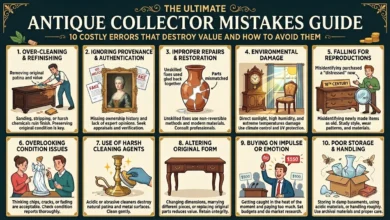
Common Mistakes to Avoid
- Using aggressive detergents on furniture
- Stacking porcelain without protective padding
- Exposing objects to direct light, humidity, or temperature changes
- Ignoring repairs that may affect authenticity
Starting a Rare Antique Collection
Strategic Approaches for Beginners
Experienced collectors recommend focusing on quality over quantity: “a few selected pieces teach more than many common objects” .
Practical Starting Strategies:
- Single ruler/period focus: Coins from Roman Emperor Augustus or Gothic period objects
- One type over time: Guilders, Roman denarii, or specific furniture types
- Specific mint or workshop: Barberi micromosaics, Venetian filigree
- Thematic collection: Objects with animal motifs, religious themes, or trade connections
Where to Buy
- Specialized auction houses: Sotheby’s, Aguttes, Catawiki
- Reputable dealers: LAPADA-registered dealers provide guarantees
- Verification requirements: Always request provenance documentation and, for ancient items, export license verification
Documentation Best Practices
- Photograph all objects upon acquisition
- Note condition findings
- Store receipts, certificates, and provenance records
- Consider professional appraisal every 5 years for insurance
Frequently Asked Questions (FAQs)
Q1: What is the rarest type of European antique?
Medieval silver objects—particularly complete, undamaged pieces—are among the rarest due to historically low survival rates. Gothic hanaps, for example, are frequently mentioned in 14th-century inventories but extremely rare in public sales today .
Q2: How can I verify if a Roman artifact is legally obtained?
Legitimate sellers can prove legal acquisition and arrange necessary export licenses. Documentation should include provenance statements, previous collection history, and for cross-border sales, a “passport for cultural object” .
Q3: Why are some micromosaic pieces worth more than others?
Microscopic details determine value. For the Capitoline Doves subject, pieces showing the dove’s reflection in water—and especially water ripples—are extremely rare. Only 3 of 6 Gilbert Collection examples feature the reflection detail .
Q4: Should I clean an antique coin I just purchased?
Never. Cleaning or polishing damages the natural patina, which is a sign of authenticity. Improper cleaning can reduce a coin’s value by 50-90%. Store in acid-free holders and handle as little as possible with bare hands .
Q5: What does “provenance” mean and why does it matter?
Provenance is the documented ownership history of an object. It provides historical context, helps authenticate the piece, and can substantially increase value—especially if previous owners were notable figures like Emperor Napoleon III or Prince Demidoff .
Q6: How do I know if a mark on silver is a genuine hallmark?
Hallmarks should be examined by specialists. Even “unidentified” marks can provide authentication evidence through their style, placement, and comparison with known examples. Work with accredited appraisers or auction house experts .
Q7: What’s the best way to start collecting with a limited budget?
Focus on a specific, manageable theme such as coins of a single ruler, one type of object over time, or a particular historical period. Quality over quantity—a few well-chosen, documented pieces are more valuable than many common objects .
Image Suggestions for This Article
- Ancient Roman enameled fibula with triangular arch (alt: “rare Roman enameled fibula triangular arch 100AD”)
- Gothic silver hanap with gilt-edged border and architectural festoons (alt: “14th century French Gothic silver hanap”)
- Italian silver-gilt filigree and rock crystal casket, circa 1700 (alt: “Venetian filigree rock crystal casket 1700”)
- Micromosaic snuff box by Gioacchino Barberi with Capitoline Doves (alt: “Barberi micromosaic snuff box Capitoline doves 1810”)
- Roman bronze zoomorphic brooch shaped as two roosters (alt: “rare Roman bronze zoomorphic brooch roosters 1st century”)
- Comparative image: micromosaic detail showing dove reflection vs. without (alt: “micromosaic dove reflection comparison rare detail”)
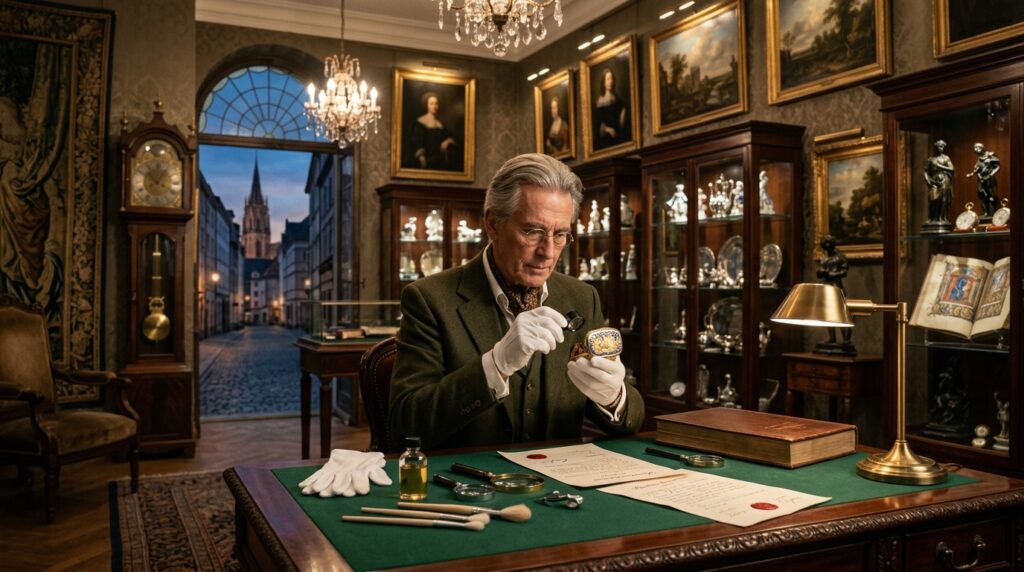
- Conservation environment setup for silver and enamel artifacts (alt: “proper storage conditions for rare European antiques”)