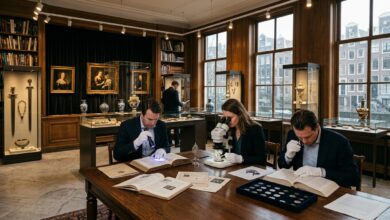
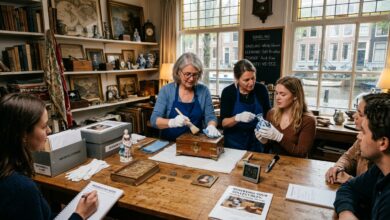
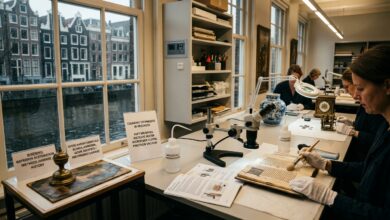
The Definitive Rare Object Authentication Guide: Scientific Methods, Expert Techniques, and Red Flags
The discovery of a rare object—whether a dusty painting in an attic, a mysterious coin at a flea market, or a document passed down through generations—is exhilarating. But the thrill quickly turns to anxiety when the question arises: is it real? With sophisticated forgeries flooding the market and counterfeiters using increasingly advanced techniques, authentication has never been more critical or more complex.
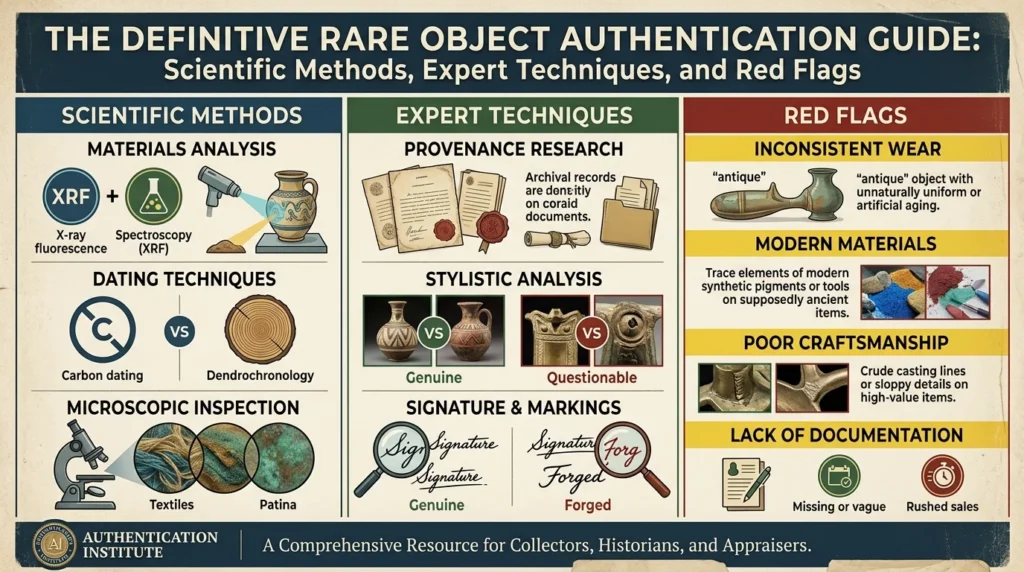
This comprehensive guide explores the professional methods used to authenticate rare objects, from non-destructive scientific analysis to the art of forensic provenance research. Whether you are evaluating a potential purchase, assessing a family heirloom, or simply curious about how experts separate genuine artifacts from clever fakes, this guide provides the essential knowledge to become a more discerning collector.
Part 1: The Multidisciplinary Approach – Why One Test Is Never Enough
Authenticating a rare object is rarely straightforward. The key to detecting forgery lies in the fact that every object contains within itself evidence of the time and place in which it was made . The two main approaches—stylistic and technical analysis—are complementary and are best used together.
The Four Pillars of Authentication
Professional authentication relies on the convergence of multiple lines of evidence, not a single “magic bullet” test. Reputable dealers and museums consider four primary categories of evidence simultaneously :
| Evidence Category | What It Examines | Key Questions |
|---|---|---|
| Art Historical | Style, iconography, brushwork, composition | Does the style match the claimed era and artist? |
| Technical | Manufacturing methods, tool marks, construction | Are production techniques consistent with the period? |
| Scientific | Material composition, corrosion, aging patterns | Do scientific tests confirm the claimed age? |
| Provenance | Ownership history, documentation, exhibition records | Can the object’s path through history be traced? |
Part 2: Scientific Authentication Methods Explained
Modern technology has revolutionized the authentication of rare objects. Non-destructive techniques allow experts to analyze materials without damaging the objects themselves.
Neutron Imaging for Metal Objects
Researchers at the National Institute of Standards and Technology (NIST) have demonstrated a method using beams of low-energy neutrons to distinguish century-old coins from modern fakes . Neutrons penetrate heavy metals such as copper, iron, and lead and interact strongly with hydrogen-bearing compounds that form as byproducts of corrosion .
How It Works:
- Neutron tomography takes a series of 2D images from different perspectives as the object rotates
- These snapshots are combined to reveal the 3D structure of the object
- Neutron grating interferometry records neutrons scattered at small angles, revealing microstructures such as pitting and pores that are signs of corrosion
What Neutron Imaging Reveals:
- In authentic coins, corrosion penetrates deep within the body, indicating gradual degradation over decades
- In replicas, corrosion is mainly confined to the surface, consistent with rapid corrosion over a short time period
- Pore size provides another distinction: authentic coins have much smaller pores (micrometers to nanometers) compared to millimeter-sized pores in replicas
| Authentic Indicator | Replica/Fake Indicator |
|---|---|
| Corrosion penetrating deep within the body | Corrosion confined to surface |
| Small pores (micrometers to nanometers) | Large pores (millimeters) |
| Gradual, even degradation | Rapid, surface-only deterioration |
X-Ray Fluorescence (XRF) for Glass and Metal
XRF is one of the most powerful tools for authenticating glass and metal objects. The technique works by directing X-rays at an object, causing it to emit fluorescent light that reveals its elemental composition.
Applications for Glass Beads:
A multi-analytical study on historical glass beads identified specific markers that distinguish authentic pieces from modern forgeries :
| Component | Authentic Historical Beads | Modern Beads |
|---|---|---|
| Antimony | Present | Absent |
| Boron, Zinc, Molybdenum | Absent | Detected |
| Opacifiers | Tin oxide or calcium antimoniate | ZrO2 microcrystals or fluorine ions |
| Yellow color | Lead antimoniate or iron | Cadmium sulfoselenide |
| Green color | Iron and/or copper | Chromium |
Key Finding: Laser Induced Breakdown Spectroscopy (LIBS) has been validated and proven feasible for in situ analysis of historical glass objects, regardless of their size, provenance, or chronology .
Micro-Computed Tomography (μ-CT) for Stone and Ceramic Artifacts
X-ray micro-computed tomography has become an invaluable tool in cultural heritage study due to its non-invasive capability to visualize the inner part of an object .
Application for Lapis Lazuli:
Researchers developed an innovative workflow to investigate the provenance of lapis lazuli used in antiquity. The method uses μ-CT to evaluate the alteration state of pyrite crystals within the entire volume of the rock and identify the most suitable crystals for subsequent analysis .
This technique was successfully applied to three lapis lazuli beads from the ancient Royal Cemetery of Ur (Mesopotamia, 3rd millennium BCE), proving for the first time using micro-invasive analysis that the raw material matched Afghan quarry sources .
The Non-Destructive Advantage
X-ray computed tomography has also emerged as a powerful non-destructive method for inferring production techniques in glass beads. The technique distinguishes between:
- Use of a rotating mandrel
- Application of successive glass layers formed after blowing
- Identification of successive superimposed layers with variations in doping elements and compositional gradients
| Technique | Best For | Invasiveness |
|---|---|---|
| Neutron Imaging | Metal coins and artifacts | Non-destructive |
| XRF (X-Ray Fluorescence) | Glass, metal, surface composition | Non-destructive |
| μ-CT (Micro-Computed Tomography) | Stone, ceramic, internal structure | Non-destructive |
| LIBS (Laser-Induced Breakdown) | Glass, elemental analysis | Micro-invasive |
| Radiocarbon Dating | Organic materials (wood, textile, bone) | Destructive (sample required) |
| Thermoluminescence | Ceramics (clay firing date) | Destructive (sample required) |
Part 3: The Art of Stylistic Analysis
While scientific methods provide objective data, the human eye remains essential in authentication. Stylistic analysis, though subjective, offers critical insights that machines cannot replicate .
What Stylistic Analysis Examines
Each artist has a unique style—a flair, a verve that can be recognized. This style changes throughout a career, and these changes can be documented from known works .
Key Elements of Stylistic Analysis:
| Element | What to Examine |
|---|---|
| Brushwork | The idiosyncrasies of an artist’s stroke, similar to handwriting analysis |
| Choice of colors | Palette consistency with known works from the period |
| Composition | Subject matter, arrangement, and spatial relationships |
| Iconography | Correct combination of symbolic elements (forgery often reveals errors here) |
A forger rarely has the scholarly background to combine iconographic elements correctly, and their errors often betray them .
Functional Purpose as Evidence
Ancient works were made for functional purposes. A forger usually makes an attractive piece that is often inconsistent with that purpose. As they were used, most ancient pieces developed signs of wear—and these rubbed and worn areas should appear in logical places on the object .
Part 4: Provenance – The Object’s Biography
Provenance—the documented history of an object’s ownership—is one of the most powerful tools in authentication. Gaps in provenance do not automatically indicate a fake, but they do raise questions that require investigation .
What Is Provenance?
Provenance can establish legitimacy, situate a work within an artist’s broader practice, and signal institutional or scholarly confidence. Exhibition history, publication references, and notable prior ownership often reinforce credibility and desirability .
Key Provenance Resources:
| Resource Type | What It Provides |
|---|---|
| Auction catalogs | Sale records, previous owners, prices |
| Dealer records | Transaction history, chain of custody |
| Exhibition histories | Museum and gallery provenance |
| Collection marks | Bookplates, stamps, inventory numbers |
Experience Is the Foundation
Nathan Raab, a second-generation rare documents dealer and co-author of “The Hunt for History,” explains that experience is fundamental to authentication: “Like any profession, to be really good at something, you need repetition and experience. Once you’ve seen hundreds of letters by someone, anything that’s off will jump out” .
Spotting a fake takes more than an eye for handwriting: “It’s not just looking at a signature and a line here and there. It’s understanding the context of the piece, the ink used, the format” .
Provenance Breakdowns
Challenges around authentication often emerge not at the moment of purchase, but later—when the asset needs to be sold, financed, transferred, or donated . Common points of breakdown include:
| Issue | Consequence |
|---|---|
| Gaps in ownership history | Reduced market confidence |
| Conflicting expert opinions | Impaired liquidity |
| Changes in attribution | Temporary unmarketability |
| Ambiguous documentation | Conservative valuation assumptions |
Part 5: Material-Specific Red Flags
Different categories of objects have distinct red flags that signal potential forgery or misattribution.
Paintings
Ultraviolet rays readily reveal additions or alterations to a painting, since varnish layers and some paint layers fluoresce to different colors .
UV Fluorescence Indicators:
- Old marble fluoresces to a yellow-greenish color
- Modern marble or recently recut surfaces fluoresce to bright violet
Infrared rays can penetrate thin paint layers to reveal underpainting that may disclose an earlier painting on the same canvas, or perhaps a signature that has been painted out and covered by a more profitable one .
X-rays are used to examine the internal structure. A carved wooden Virgin supposedly from the 15th century but revealing modern machine-made nails deep inside is obviously a fraud—a forger usually works for the surface effect and is not concerned with internal structures .
Documents and Manuscripts
Most people who possess fakes aren’t looking to fool anyone—on the contrary, they’ve usually been fooled themselves . A careful examination of documentation often detects forgery, as the apparent authenticity of many spurious pieces is bolstered by false documents attesting to point of origin, former owners, and expert opinions .
Pigments and Materials
Chemical analysis is particularly valuable for determining the pigment used because many paints available to the modern forger were unknown in earlier times .
| Time Period | Characteristic Pigments |
|---|---|
| Pre-20th century | White lead (for white), natural minerals (lapis lazuli for blue, malachite for green) |
| 20th century | Titanium white (a 20th-century product), synthetic chemicals |
A speck as small as the head of a pin can be analyzed spectrographically. From the burning of a minute sample, a photographic record of the spectrum of light emitted reveals the elements present and their relative percentages .
Part 6: The Forger’s Tell – Artificial Aging
The hardest deception to detect is usually one that has been made recently. The forgery is a product of the time in which it was made, and the forger is closer to current understanding of the artist or period forged .
How Forgers Create Age
Forgers use various techniques to artificially recreate the passage of time on objects . However, the microscope is the most useful basic tool: a close examination of the physical condition often will show if aging is genuine or has been artificially induced .
Signs of Artificial Aging:
- Uniform wear patterns (genuine wear is concentrated on high-touch areas)
- Sanding marks or uniform distressing
- Jumbled or missing corrosion layers
- Clean crazing lines (authentic age produces dirt-stained cracks)
Part 7: The Authentication Process in Practice
Professional authentication follows a rigorous, multi-step process.
Gallery Rare 8-Step Inspection Process
Professional dealers employ systematic authentication protocols :
- Initial Purchasing: Professional buyers inspect items before purchase
- Pre-shipping reinspection: Items are reinspected before shipping to central division
- Product Management Division inspection: Professional inspectors with wide-ranging expertise examine items
- Photo and listing preparation: Photography team inspects condition
- Pre-listing inspection: Items are again inspected before online publication
- Pre-store shipment inspection: Thorough inspection before shipping to physical locations
- Store arrival inspection: Local staff ensures no shipping damage
- Final customer inspection: Last verification before shipping to customer
Counterfeit Databases
Professional organizations maintain databases of confirmed counterfeit products. The AACD (Association Against Counterfeit Product Distribution) in Japan, for example, ensures that all items sold meet strict regulations and standards. AACD-qualified authenticators have more than 10 years of experience in the industry .
Part 8: When Experts Disagree – The Limits of Authentication
Authentication is rarely absolute and almost never static. It is built through accumulated evidence rather than a single point of certainty .
What This Means for Collectors
Part 9: Practical Authentication Checklist for Collectors
Before purchasing a rare object, run through this professional-grade checklist.
Pre-Purchase Investigation
Provenance Verification:
- Request documented ownership history
- Verify chain of ownership where possible
- Check for gaps that coincide with known thefts or conflicts
- Look for exhibition records and publication citations
Physical Examination:
- Inspect with magnification (10x loupe minimum)
- Check for signs of artificial aging (uniform wear, sanding marks)
- Examine all surfaces, including back and bottom
- Note any restoration or repair evidence
Documentation Review:
- Examine certificates of authenticity critically
- Verify dealer credentials and reputation
- Request scientific testing documentation when applicable
Red Flags That Should Stop a Purchase
| Red Flag | Action Required |
|---|---|
| Seller cannot provide provenance | Do not buy without independent verification |
| Item shows uniform wear patterns | Likely artificially aged |
| Price is “too good to be true” | Suspicious; forgeries are priced to move quickly |
| Seller refuses testing or inspection | Walk away; legitimate sellers accommodate serious buyers |
| No documentation of restoration | Assume hidden repairs; adjust value accordingly |
Frequently Asked Questions (FAQ)
Q1: What is the most reliable scientific test for authenticating rare objects?
A: No single test is definitive. Neutron imaging has proven highly effective for metal coins, XRF for glass and surface composition, and μ-CT for internal structure analysis. The most reliable approach combines multiple scientific methods with stylistic analysis and provenance research .
Q2: How can neutron imaging distinguish real coins from fakes?
A: Neutron imaging reveals corrosion patterns and pore sizes. In authentic coins, corrosion penetrates deep within the body and pores are very small (micrometers to nanometers). In replicas, corrosion is confined to the surface and pores remain large (millimeters) .
Q3: What does XRF testing reveal about glass beads?
A: XRF reveals elemental composition. Authentic historical beads contain antimony and use tin oxide or calcium antimoniate as opacifiers. Modern beads contain boron, zinc, or molybdenum and use ZrO2 or fluorine as opacifiers .
Q4: Why is provenance so important for authentication?
A: Provenance provides a documented chain of ownership that can verify an object’s age and origin. Gaps in provenance do not necessarily indicate a fake, but well-documented provenance significantly increases both confidence and value. Without credible authentication and clear ownership history, even high-quality assets can become difficult to sell, insure, or finance .
Q5: Can stylistic analysis alone authenticate an object?
A: No. Stylistic analysis is subjective and rests on the astute eye of the art historian. While valuable, it should always be combined with technical and scientific analysis. The two approaches—stylistic and technical—are complementary and best used together .
Q6: What are the most common red flags for forged paintings?
A: Ultraviolet fluorescence that doesn’t match the claimed period, infrared reveal of altered underpainting, X-ray detection of modern materials (like machine-made nails), and pigments that weren’t available in the claimed era (such as titanium white in a pre-20th century painting) .
Q7: How do professional authenticators spot fake documents?
A: Through experience examining hundreds of authentic examples. As Nathan Raab explains, once you’ve seen hundreds of letters by someone, anything off will jump out. Experts examine handwriting, ink, format, context, and the piece’s overall “sniff test” .
Q8: Are there professional organizations that set authentication standards?
A: Yes. The AACD (Association Against Counterfeit Product Distribution) in Japan maintains strict regulations and standards. AACD-qualified authenticators have more than 10 years of industry experience and hold regular appraisal training .
Q9: Can authentication ever be 100% certain?
A: Rarely. Authentication is usually the result of a process that includes scholarly research, expert attribution, scientific analysis, and acceptance by the market over time. It is built through accumulated evidence rather than a single point of certainty .
Q10: What should I do if I suspect I own a forged object?
A: Consult a professional appraiser or authentication expert. Do not attempt to clean or alter the object, as this may destroy evidence. Be prepared for the possibility that the object may have little to no market value, though it may still hold sentimental or educational value.
rare object authentication guide scientific methods for authenticating antiques XRF testing for collectibles provenance research tips how to spot forged artifacts neutron imaging authentication professional appraisal services