The Ultimate Guide to Mysterious Vintage Artifacts: History’s Most Baffling Objects Explained
Part 1: What Makes an Artifact “Mysterious”?
Not every old object qualifies as a mystery. The most intriguing vintage artifacts share common characteristics that set them apart from routine archaeological finds.
Defining the Mysterious Artifact
A truly mysterious artifact is one that possesses one or more of the following qualities:
| Characteristic | Description | Example |
|---|---|---|
| Unknown Purpose | The object’s function cannot be determined | Roman dodecahedra |
| Undeciphered Text | Writing systems that resist translation | Voynich Manuscript |
| Anachronistic Technology | Technology ahead of its time | Antikythera Mechanism |
| Unexplained Origin | Cannot be attributed to known culture | Diquís Spheres |
| No Known Parallels | Unique object with no comparable finds | Peebles Hoard silver surfaces |
When experts encounter such objects, they face a fundamental challenge: these artifacts are often so singular that there is nothing to compare them against. As researchers have noted, many mysterious artifacts were excavated before modern scientific methods existed, or they came from collectors who divorced them from their original archaeological context, making interpretation nearly impossible .
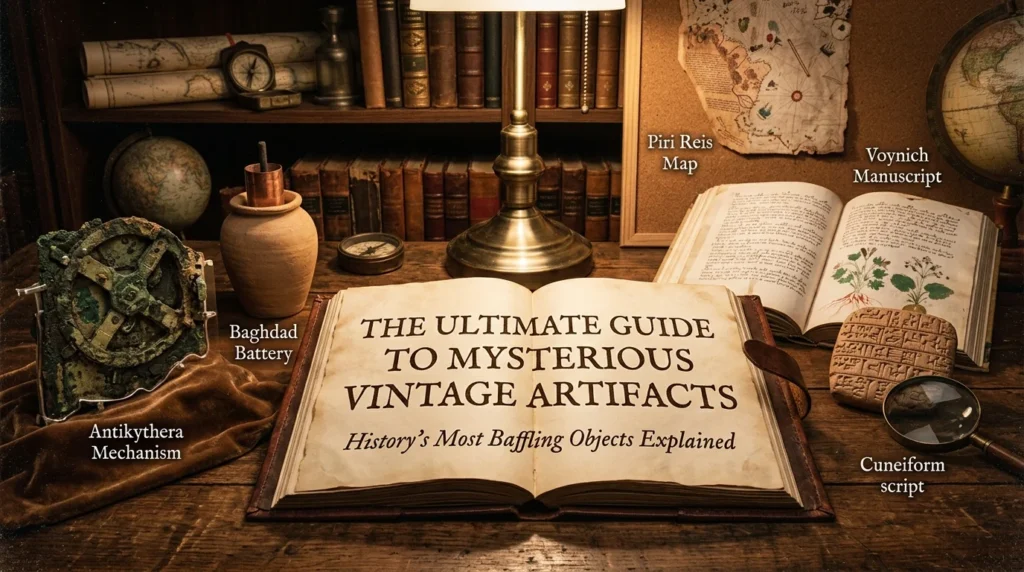
Part 2: The Most Famous Mysterious Vintage Artifacts
The Voynich Manuscript: The Book No One Can Read
If you could hold the Voynich Manuscript at Yale University’s Beinecke Library, the first thing you would likely feel is frustration disguised as fascination. You are looking at a thick fifteenth-century book filled with flowing script, astronomical diagrams, odd plants that seem almost but not quite real, and nude figures bathing in greenish pools that look like alchemical plumbing .
Carbon dating places the vellum around the early 1400s, but when you try to read even a single line, it becomes clear: you have no idea what language this even is. For over a century, professional cryptographers, linguists, computer scientists, and enthusiastic amateurs have tried to crack it. You can still follow new debates published as recently as 2026 about whether it is a sophisticated cipher, a natural language, or an elaborate medieval hoax .
When you look at the statistics of the text, it behaves oddly like a real language—showing patterns consistent with natural human communication. But every proposed decoding collapses under scrutiny. The more you learn, the more you feel as if you are standing outside a locked room, hearing muffled voices, knowing full well that you might never get inside in your lifetime.
The Antikythera Mechanism: A Bronze Age Computer
When you picture ancient Greece, you probably imagine stone temples and marble statues, not a corroded box of clockwork that behaves like a mechanical computer. Yet that is exactly what the Antikythera Mechanism is: a dense cluster of bronze gears recovered from a shipwreck near the island of Antikythera, dated to roughly the second to first century BCE .
Once modern imaging peeled back the encrusted metal, you could suddenly see carefully cut gear teeth, inscriptions, and dials that model the motions of the Sun, Moon, and eclipses with startling precision. Today you know fairly well what many of the surviving parts did, and reconstructions can even reproduce its astronomical displays. But the artifact still baffles you because it sits there like a single page torn from an otherwise missing manual .
Some researchers now wonder whether the device might have also served as a teaching tool or even a kind of elite “toy.” But until more examples surface, you are left staring at an isolated technological miracle and wondering how much ancient knowledge simply sank to the seafloor with it .
The Roman Dodecahedra: Twelve-Sided Enigmas
So far, 33 of these unusual twelve-sided objects have been discovered in Britain, including a recent discovery of a 3-inch-tall bronze dodecahedron found in Lincolnshire. While the objects vary in size and decoration, they frequently have a series of different-sized holes on each face and round balls on each corner .
As beautiful and fascinating as these objects may be, studying them has proved to be a fiendishly difficult challenge. Romans did not visually depict or write about dodecahedra. There are no inscriptions, texts, or images. You would think that a mosaic, painting, or long-lost classical text might be discovered that explained everything about dodecahedra, but nothing has appeared .
The puzzle has been made even more difficult by the fact that they were highly prized by collectors in the 18th century. The resulting “horse trading” means that many of the artifacts became divorced from their archaeological context, making it tricky to piece the details together.
Part 3: Rediscovered Treasures from Storage
Not all mysterious artifacts are ancient. Sometimes, objects hide in plain sight within museum collections for decades, waiting for the right expert to recognize their true significance.
The Lamashtu Amulets: Protective Magic from Mesopotamia
At the Penn Museum, Near East Keeper Katherine Blanchard recently made a remarkable discovery while revisiting artifacts catalogued over a century ago. What she found demonstrates that museums still hold secrets waiting to be uncovered .
The Mesopotamian demoness Lamashtu was a terrifying figure—cast out of the heavens after developing a taste for human blood, particularly that of unborn children. Ancient tablets record ways to keep her away, including specific incantations, figurines and plaques to put up in your home, and protective amulets that one could wear .
A year ago, the Penn Museum’s collection had one known Lamashtu amulet. After careful study of the common attributes of such objects, Blanchard began re-examining other spade-shaped pendants in storage. Suddenly, objects that had been sitting in drawers for nearly a century revealed their true identity .
One pendant, excavated at the site of Nippur in 1895, was so unique that a rubbing was made of each side in the field and sent to the Museum’s director. It was unknown at the time but was noted as likely playing a role in the protection of the wearer. After 93 years, this object was finally re-catalogued correctly as a Lamashtu amulet—no longer identified as a “crudely etched man” .
The Peebles Hoard: A Bronze Age Wonder
In Scotland, conservators are working on an almost 3,000-year-old Bronze Age hoard that experts say is unlike anything seen before. Discovered by a metal detectorist in 2020, the Peebles Hoard contains more than 500 unusual bronze and organic objects, many of which have no known archaeological parallels anywhere in the world .
Dating from 1000 to 800 BC, the hoard includes two rattle pendants, a sword encased in a wooden scabbard, and bronze buttons strung on cords. Conservation work at the National Museums Scotland has uncovered rare silver-colored surfaces on several objects—a striking effect achieved despite the fact that silver itself was unknown at the time .
Analysis has shown that the sheen is caused by a high concentration of tin on the surfaces, thought to be the result of deliberate enrichment techniques employed by highly skilled Bronze Age craftspeople. The function of many of the hoard’s objects remains unknown, although some are believed to have adorned horses or wooden vehicles .
Part 4: Other Unexplained Artifacts
The Towie Ball: Neolithic Mystery
The Towie Ball is a 531-gram ball of black stone believed to have been carved by Neolithic people in Scotland more than 5,000 years ago. Three of the ball’s four carved faces are marked by intricate swirling patterns while the last remains strangely blank. Despite being discovered in 1860, the reason this strange object was made largely remains a mystery .
What makes this puzzle all the more frustrating is that this is just one of around 430 different stone balls found mainly along the eastern coast of Scotland. While hundreds were found, many were considered curios and were sold or sat gathering dust in private collections. This has made it difficult to know exactly where and when they were made .
One popular theory is that these were a form of high-status weapon among stone-age people. However, the balls are remarkably undamaged despite their great age, and other random stones would have been just as effective without needing to be carved. Instead, researchers suggest the balls could have had a symbolic rather than practical purpose—perhaps evoking the circular shape of homes with ridges standing for the hills and valleys of Scotland .
The Diquís Spheres: Perfectly Round Stone Balls
Almost perfectly round and up to two meters (six feet) tall, the Diquís Spheres of Costa Rica have resisted understanding for almost a century. Hundreds can be found on the island Isla del Caño and the Diquís Delta. Despite decades of study, no one knows why so much effort was put into carving these bizarre objects .
The Phaistos Disc: Ancient Moveable Type
Imagine picking up a clay disc from Bronze Age Crete, about the size of your hand, and realizing you are staring at the world’s oldest example of moveable type. That is what you get with the Phaistos Disc: two spiral bands of stamped symbols—tiny human figures, tools, plants, abstract shapes—running inward like a coiled riddle .
It was unearthed in 1908 at the Minoan palace site of Phaistos and is usually dated somewhere in the second millennium BCE. Yet to you it might as well have been made yesterday because nobody has coaxed a trustworthy translation from it. There is one artifact, about forty-five distinct signs, and not a single bilingual “Rosetta Stone” to check your guesses .
Part 5: How Experts Uncover the Secrets of Vintage Artifacts
Understanding how professionals analyze and date mysterious artifacts can help you approach your own vintage discoveries with confidence.
The Research Process
When experts encounter an unidentified object, they follow a systematic process :
Step 1: Examine Maker’s Marks and Backstamps – The easiest place to start is with any markings on the object. For ceramics, the maker’s mark is the name or symbol placed on the back or bottom indicating which company manufactured the item. Over time, brands often change their maker’s mark, which assists researchers in determining when objects were produced .
Step 2: Identify Pattern and Design – Reverse image searching a picture of an object can help determine its pattern. For example, a Spode tea set pattern called Maritime Rose was identified through this method, with online resources indicating it was discontinued in 1972 .
Step 3: Consult Reference Books – Specialized reference works, such as “Miller’s Antiques Marks” which contains more than 6,000 marks, provide invaluable assistance. Some books are written by individuals affiliated with the manufacturers themselves, making the information trustworthy .
Step 4: Look for Date Marks – Many quality items have impressed marks that were pressed into the piece before it dried. These can correspond to specific months and years of production .
Step 5: Examine Retailer’s Marks – The stamp indicating where an object was purchased can provide a time frame. If a retailer operated at a specific address only between certain years, any item with that mark must date from that period .
The Challenge of Forgeries and Misidentifications
One of the greatest challenges in identifying vintage artifacts is distinguishing genuine age from deliberate artifice. In antique jewelry, for instance, gemstones are often re-cut and re-used over centuries. Experts examine wear marks, smoothed-out facet edges, and drill hole patterns to determine whether a stone is original to a piece or a later replacement .
When examining an antique brooch from the late 19th century, gemologists at SSEF discovered that the central “emerald” was actually lead glass. However, the nature of the wear and the style of the setting suggested this replacement was not recent but had already occurred during the late 19th or early 20th century—making it historically significant in its own right .
Part 6: Why Some Mysteries Remain Unsolved
Despite modern technology—including X-ray imaging, reflectance transformation imaging (RTI), carbon dating, and advanced chemical analysis—many artifacts remain stubbornly mysterious .
The Problem of Lost Context
Lorena Hitchens, an archaeologist studying Roman dodecahedra for her PhD at Newcastle University, explains that “for some people, an unsolved mystery is really hard to accept.” However, she warns that the lack of evidence has not stopped wild theories and rampant speculation .
She notes that “this kind of speculation is not based on real evidence. Sometimes people see what they want to see when they look at these objects.” For example, it is often claimed that dodecahedra were used as a type of knitting aid. While it is possible to use the balls on the corners of the object to weave tubes of material, there is no evidence that these objects were ever used in this way .
The Value of Mystery
As one researcher noted, “Things aren’t often ‘discovered’ in storage. What happens is someone with advanced knowledge is able to spend time with material and see things anew” . This is why proper cataloguing and preservation are so important. Every day, someone has the chance to see something new—a piece on display or a piece in storage. None are dusty nor ignored, and there is always more to learn .
Frequently Asked Questions (FAQ)
Q1: What is the most mysterious artifact ever discovered?
A: The Voynich Manuscript is widely considered the most mysterious artifact due to its undeciphered writing system. Despite over a century of attempts by cryptographers, linguists, and computer scientists, no one has definitively translated a single word of its 240 pages .
Q2: How can I tell if a vintage artifact I own is valuable?
A: Look for maker’s marks or hallmarks on the bottom or back. Consult reference books like “Miller’s Antiques Marks” which contains over 6,000 examples. Examine construction techniques—hand-cut dovetails, irregular saw marks, and wooden pegs suggest age, while machine-cut dovetails or MDF backing suggest reproduction .
Q3: What is the Antikythera Mechanism and why is it mysterious?
A: The Antikythera Mechanism is a 2,000-year-old mechanical computer made of bronze gears that could calculate the movements of the Sun, Moon, and planets. It is mysterious because such complex gear technology was not believed to exist until the 14th century, and no other similar device from that era has ever been found .
Q4: Why can’t experts decipher the Phaistos Disc?
A: The Phaistos Disc contains about 45 distinct symbols stamped into clay, but there is no “Rosetta Stone” equivalent to provide a translation key. With only one example of this writing system in existence, linguists have no way to confirm any proposed translation .
Q5: What are Roman dodecahedra?
A: Roman dodecahedra are hollow twelve-sided bronze objects found primarily in the Celtic regions of the Roman Empire. They have circular holes of different sizes on each face and rounded knobs at each corner. No Roman text or image mentions them, and their purpose remains unknown .
Q6: How do museums discover new artifacts in their own collections?
A: Museums often have objects that were catalogued decades ago when less comparative material existed. As new discoveries are made and knowledge advances, curators can revisit old collections and reinterpret objects. Advanced imaging techniques like reflectance transformation imaging (RTI) can reveal details invisible to the naked eye .
Q7: Is the Shroud of Turin a genuine relic or a medieval forgery?
A: Radiocarbon dating carried out in the late 1980s pointed toward a medieval origin between the 13th and 14th centuries. However, the way the image formed on the cloth has still not been fully explained. No experiment has yet replicated all of the Shroud’s microscopic features to everyone’s satisfaction, leaving the debate unresolved .
Q8: What is the Peebles Hoard?
A: The Peebles Hoard is a collection of over 500 Bronze Age objects discovered in Scotland in 2020, dating from 1000 to 800 BC. Many objects have no known archaeological parallels anywhere in the world. Conservation has revealed a rare silver-colored sheen achieved through deliberate tin enrichment, despite silver itself being unknown at the time .