The Ultimate Collectible Object Comparison Guide: Antique vs. Vintage vs. Retro vs. Reproduction
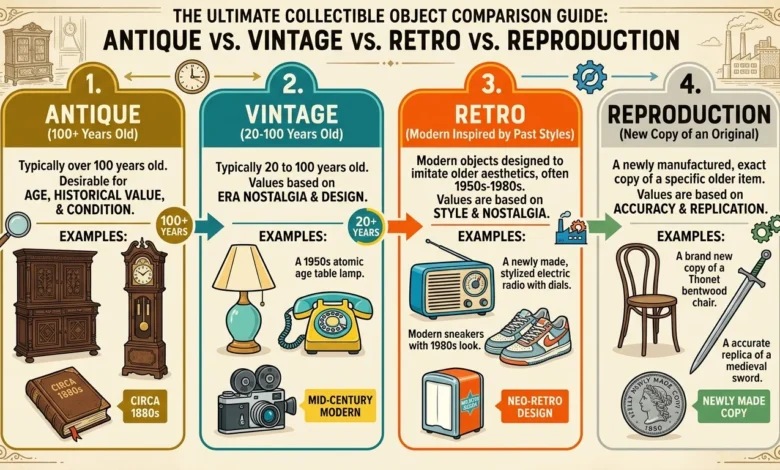
Part 1: Definitions at a Glance – The Core Categories
Before comparing specific objects, it is essential to establish clear working definitions for each major collectible category. While some debate exists within the trade, these definitions represent the consensus among professional appraisers, auction houses, and customs authorities .
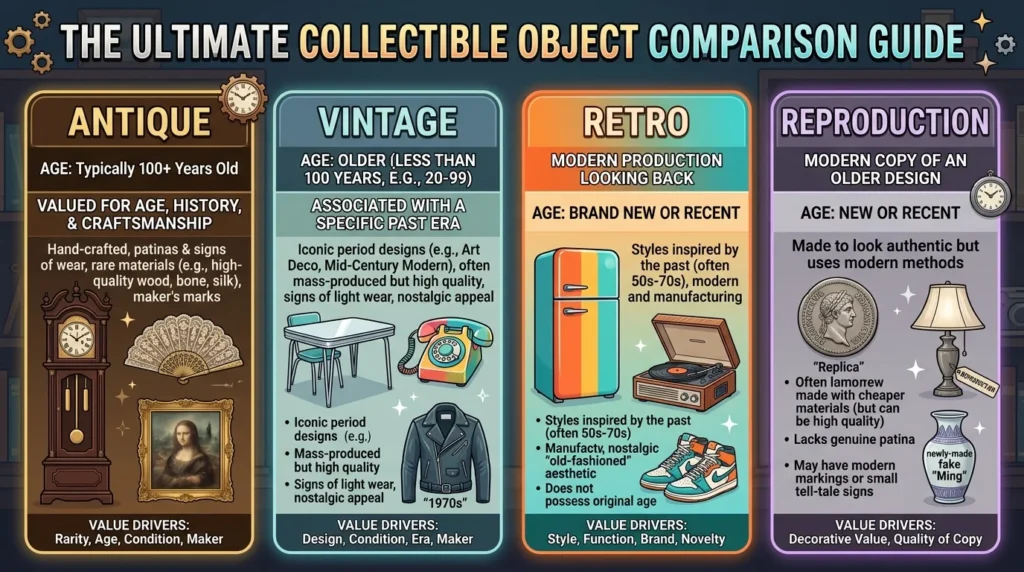
| Category | Age Range | Key Characteristics | Value Drivers |
|---|---|---|---|
| Antique | 100+ years old | Handcrafted, pre-Industrial Revolution techniques, historical significance, natural patina | Rarity, provenance, condition, craftsmanship quality, historical importance |
| Vintage | 20 to 99 years old | Represents specific era, recognizable style, often mass-produced but quality-made, nostalgia appeal | Era authenticity, condition, brand recognition, current fashion trends |
| Retro | Can be brand new | Designed to imitate past styles (typically 1950s–1990s), modern materials and production, nostalgic aesthetic | Design accuracy, functionality, brand, decorative appeal |
| Reproduction | Any age | Copy of an original design, often marked or intentionally distinguishable, varying quality levels | Craftsmanship accuracy, materials quality, clarity of marking as reproduction |
The 100-Year Rule Explained
The 100-year standard for antiques was not arbitrarily chosen by collectors. It was established in the 1930s by the United States Customs Office to determine which objects should be subject to import duty. True antiques were treated as artwork and exempt from tariffs, while younger objects were classified as merchandise . This distinction recognized that pre-Industrial Revolution objects were handmade and possessed artistic merit beyond their material value.
Today, this standard remains the benchmark used by major auction houses, insurance appraisers, and customs authorities worldwide. An object from 1925 or earlier qualifies as an antique; an object from 1926 is technically vintage, though some flexibility exists around the exact cutoff year .
The Legal Distinction
The difference between antique and vintage is not merely semantic—it carries legal weight. In many jurisdictions, antique dealers must meet different licensing requirements than general secondhand merchants. Antique vehicles qualify for special registration categories. Antique firearms have different transfer regulations. Understanding whether an object legally qualifies as an antique can affect import/export rights, insurance coverage, and sales tax obligations.
Part 2: Direct Object Comparisons – How Categories Differ by Item Type
The distinctions between collectible categories become most meaningful when applied to specific types of objects. This section compares how the same category of object manifests differently across the collectible spectrum.
Furniture Comparison
Furniture is one of the most instructive categories for understanding collectible hierarchies because production methods changed dramatically over time .
| Feature | Antique Furniture (Pre-1925) | Vintage Furniture (1925–2005) | Reproduction Furniture |
|---|---|---|---|
| Joinery | Hand-cut dovetails (irregular, asymmetrical), wooden pegs, mortise and tenon | Machine-cut dovetails (uniform), some hand finishing, glue blocks | Varies; high-end uses authentic methods, low-end uses staples and cam locks |
| Materials | Solid hardwoods (mahogany, walnut, oak), hand-planed surfaces, no plywood | Solid woods plus veneers, plywood in hidden areas (post-WWII), particle board from 1970s | Often MDF, particle board, or softwoods disguised as hardwoods |
| Hardware | Hand-forged nails (irregular heads), slotted screws (hand-cut threads), brass with natural patina | Machine-made screws (Phillips heads post-1930s), cast brass, some original finishes | Modern screws, mass-produced pulls, often new metal aged artificially |
| Marks | Often no factory marks; handmade pieces may have carver’s marks or chalk signatures | Manufacturer labels, date stamps, union marks, model numbers | Often marked “reproduction,” “style of,” or have modern brand labels |
Real-World Example: Duncan Phyfe Furniture
The case of Duncan Phyfe furniture perfectly illustrates the value gap between authentic antique, vintage style, and reproduction. An original Duncan Phyfe dining table from 1815 sold for 132,000in2006[citation:2].Bycontrast,aDuncanPhyfe−stylediningroomsetfromthe1940sor1950s—furnituremadeinthemannerofPhyfebutnotbyhisworkshop—retailsforapproximately2,000 for a six-piece set .
The key distinction is the word “style.” A Duncan Phyfe table is authentic; a table in the “style of Duncan Phyfe” is a later interpretation, regardless of its age. The same principle applies to Tiffany, Stickley, and virtually every major furniture maker.
Silver and Metalwork Comparison
Silver hallmarks provide one of the most precise dating systems in the collecting world, making silver an excellent category for understanding age-based classification .
| Feature | Antique Silver (Pre-1925) | Vintage Silver (1925–2005) | Silver Plate |
|---|---|---|---|
| Purity Marks | Sterling (925), Britannia (958), or regional standards (e.g., 800, 900) | Same purity standards, but marks may be stamped rather than hand-punched | Marked “EPNS” (Electro-Plated Nickel Silver), “EP,” “Silver on Copper,” or no purity mark |
| Hallmark System | Full hallmarks: maker, assay office, date letter, duty mark (pre-1890), lion passant | Simplified hallmarks; date letters continue but often standardized; no duty mark after 1890 | No assay marks; may have maker’s name but no government assay |
| Construction | Hand-hammered surfaces, hand-engraved decoration, visible tool marks | Machine-spun or die-stamped, more uniform surfaces, cast components | Base metal (often brass or copper) with thin electroplated silver layer |
| Wear Pattern | Natural patina, softened edges from polishing, honest wear on high points | Less wear unless heavily used; often retains original finish | Worn-through silver revealing base metal (especially on raised details) |
How to Read Hallmarks
British silver hallmarks are the gold standard for authentication. A complete antique British silver mark includes :
- Maker’s Mark: Usually initials inside a shield
- Assay Office Mark: Leopard’s head for London, anchor for Birmingham, castle for Edinburgh, crown for Sheffield
- Standard Mark: Lion passant (walking lion) for sterling silver
- Date Letter: A letter indicating the specific year, changing in style and typeface annually
- Duty Mark (1784–1890): Profile of the reigning monarch, indicating tax payment
If a piece lacks these marks or has only a single stamp reading “STERLING,” it is either American (which used a less rigorous system) or a later piece from after hallmarking requirements changed .
Ceramics and Pottery Comparison
Porcelain and pottery offer distinct differences between antique, vintage, and reproduction pieces that can be identified through careful examination.
| Feature | Antique Ceramics (Pre-1925) | Vintage Ceramics (1925–2005) | Reproduction/Retro Ceramics |
|---|---|---|---|
| Glaze Characteristics | Crazing (fine cracks) with dark staining from age; uneven glaze application on early pieces | Controlled crazing; uniform glazes; often glossy finishes | New glazes; artificially applied crackle; no dirt in crazing lines |
| Manufacturing Marks | Hand-painted or impressed marks; often include factory name, pattern number, country of origin (after 1891) | Stamped or printed marks; “Made in [Country]” standard; date codes common mid-century | Often marked “reproduction,” “repro,” or “in the style of”; or deliberately aged to confuse |
| Production Method | Hand-thrown or mold-formed with hand-finishing; visible irregularities | Mold-formed with machine finishing; consistent shapes; assembly line production | Slip-cast or machine-made; often too perfect with mold lines visible |
| Decoration | Hand-painted; enamel and gilt decoration; slightly irregular patterns | Transfer-print or decal decoration; screen-printed; consistent pattern registration | Decal or printed decoration; may mimic antique styles but lacks hand-work texture |
The 1891 McKinley Tariff Act
One of the most useful dating tools for ceramics collectors is the McKinley Tariff Act of 1891, which required all goods imported into the United States to be marked with their country of origin. If a ceramic piece says “England,” “France,” or “Germany,” it was made after 1891. If it says “Made in England” or “Made in France,” it generally dates after 1914. Pieces without any country designation are likely older than 1891—or are unmarked reproductions .
Textiles and Clothing Comparison
Vintage clothing has exploded in value over the past decade, making textile dating increasingly important for collectors .
| Feature | Antique Textiles (Pre-1925) | Vintage Clothing (1925–2005) | Retro/Reproduction Clothing |
|---|---|---|---|
| Construction | Hand-sewn seams; natural fibers (linen, wool, cotton, silk); bone or metal buttons; hand-finished edges | Machine-sewn but quality finishes; natural and early synthetics (rayon from 1910s, nylon from 1930s); zippers after 1930s | Modern synthetics; overlocked seams; plastic buttons; mass production finishes |
| Labels | Often unlabeled; dressmaker labels; union labels (after 1900) | Brand labels (Dior, Chanel, Levi’s); union labels; care tags (post-1971) | Modern brand labels; deliberately vintage-style tags; often marked “vintage style” |
| Deterioration | Natural fiber aging; silk shattering; metal thread tarnish; moth damage possible | Color fading; some synthetic degradation; worn cuffs and collars | New condition; artificially distressed (pre-distressed denim, torn effects) |
A fascinating scientific study comparing 4,000-year-old ancient Egyptian flax yarns with modern French and Egyptian yarns revealed that aging significantly alters fiber structure. Ancient yarns showed more kink bands and fiber separation, indicating structural weakening and degradation of the compound middle lamella . Modern yarns fail through fiber breakage, while ancient yarns fail through a combination of breakage and fiber slippage—distinct degradation mechanisms that experts can identify microscopically.
Part 3: Comparison of Collectible Categories by Valuation Factors
Value is the bottom line for most collectors. Understanding how different categories compare on key valuation metrics helps inform buying and selling decisions.
Rarity Comparison
| Category | Typical Rarity | Why |
|---|---|---|
| Authentic Antiques | Highest | Pre-Industrial Revolution objects were handmade in limited quantities; centuries of attrition have destroyed most examples |
| Vintage (Pre-1960) | Medium-High | Mass production increased quantities, but decades of use and disposal have reduced survival rates |
| Vintage (1960–2005) | Medium | High production volumes; many survive; condition and specific desirability drive value more than scarcity |
| Retro/New Reproduction | Very Low | New items are being produced continuously; no scarcity value unless limited edition |
Condition Impact Comparison
Condition affects value across all categories, but the magnitude of impact varies significantly.
| Category | Pristine vs. Average Value Difference | Notes |
|---|---|---|
| Antique | 200% to 500% | A mint-condition antique can be worth 3–5 times an average example; original finish is critical |
| Vintage | 100% to 300% | Boxed vintage items (especially toys) command premiums of 200% or more over unboxed |
| Retro/Reproduction | 0% to 50% | Since items are new, condition differences are minor unless the item is discontinued |
Price Appreciation Trends (2025–2026 Market)
Current market analysis reveals which categories are experiencing the strongest growth .
Rapidly Rising Categories (2025–2026):
- Vintage fashion (1990s–2000s): Fendi Baguette, Dior Saddle, early Americana denim, vintage Chanel and Louis Vuitton
- 1980s–2000s toys: Original packaging Star Wars, Pokémon early editions, LEGO sets, TMNT, Nintendo and Sega games
- Mid-century modern furniture: Curvy organic forms, cane and rattan pieces, Vladimir Kagan designs
- Art Deco and Art Nouveau: Lighting, seating, Swedish Grace decorative objects
- Vintage jewelry: Signed costume pieces (Trifari, Chanel, Haskell), Native American pieces
- Victorian pottery: Minton, Wedgwood, Royal Worcester, Majolica (currently undervalued, predicted to rise)
Declining or Stable Categories:
- Mass-produced late-20th-century decorative items with no brand significance
- Damaged or heavily restored antiques
- Common pattern antique glassware with high survival rates
Part 4: How to Identify Reproductions and Fakes
The single most expensive mistake a collector can make is paying antique prices for a reproduction. Here is how to compare authentic pieces with common fakes.
Red Flags for Reproductions
| Feature | Authentic Indicator | Reproduction Red Flag |
|---|---|---|
| Dovetail Joints | Uneven, asymmetrical, hand-cut appearance | Perfectly uniform, machine-made dovetails; dovetails on drawers that should not have them historically |
| Patina | Subtle color variations, wear concentrated on high-touch areas | Uniform distressing; sanded or artificially darkened surfaces; wear in impossible places (e.g., inside a drawer front) |
| Hardware | Irregular nail heads; screws with off-center slots; natural verdigris on brass | Perfectly uniform modern screws; bright new brass; magnetic base metal under silver plate |
| Marks | Slightly irregular impressions; wear consistent with age; appropriate mark for period | Laser-etched marks (too perfect); wrong mark style for claimed period; marks that are too crisp |
| Construction Back | Old wood with darkening; hand-planing marks; appropriate joint types | Plywood or MDF; modern staples; fresh saw marks; white glue |
The “Style” Warning
When an object is described as being in the “style of” a famous maker or period, it is not authentic. A Tiffany-style lamp is not a Tiffany lamp. A Victorian-style chair was not made in the Victorian era. The word “style” indicates a later interpretation, and the value is typically 90–99% less than an authentic piece .
Scientific Authentication
When visual inspection is insufficient, professional appraisers and auction houses use scientific methods:
| Method | Application | What It Detects |
|---|---|---|
| X-Ray Fluorescence (XRF) | Metal content analysis | Modern alloys in objects claiming ancient origin |
| Thermoluminescence (TL) Dating | Ceramic dating | When clay was last fired (detects modern forgeries) |
| Carbon-14 Dating | Organic materials | Age of wood, textiles, bone (accurate to within decades) |
| X-Radiography | Internal structure | Hidden repairs, modern additions, casting methods |
Part 5: Comparison of Collecting Strategies
Different collectors pursue different goals. Comparing strategies helps you align your collecting approach with your budget and interests.
Investment-Focused Collecting
| Focus | Target Categories | Time Horizon | Risk Level |
|---|---|---|---|
| Blue-chip Antiques | Museum-quality furniture, rare silver, important paintings | 10+ years | Low (but high capital required) |
| Emerging Vintage | 1990s–2000s fashion, vintage toys, physical media | 3–7 years | Medium (trend-dependent) |
| Undervalued Categories | Victorian pottery, pine furniture, brooches | 5–10 years | Medium-Low (expertise required) |
Passion-Focused Collecting
| Focus | Target Categories | Key Consideration |
|---|---|---|
| Period Collecting | Specific era (Art Deco, Mid-Century Modern) | Define clear boundaries; build coherent collection |
| Maker Collecting | Single maker or workshop | Requires deep research; higher prices for known names |
| Theme Collecting | Objects with shared motif or function | Often more affordable; personal satisfaction primary |
Budget Considerations
| Budget Range | Recommended Focus | Why |
|---|---|---|
| Under $50 | Vintage smalls (glassware, postcards, costume jewelry), retro items | Low entry cost; learn identification skills without major risk |
| 50–500 | Vintage furniture, silver plate, unsigned pottery | Quality vintage available at this range; avoid “cheap” antiques |
| 500–5,000 | Authentic antique smalls (single items), signed vintage, high-quality reproductions | Entry point for genuine antiques; focus on condition and provenance |
| $5,000+ | Major antique furniture, rare silver, important ceramics | Requires professional appraisal; insurance recommended |
Part 6: Practical Comparison Checklist for Buyers
Before purchasing any collectible object, run through this comparison checklist to ensure you understand exactly what you are buying.
Pre-Purchase Questions
Age Confirmation:
- Is this object at least 100 years old (antique), 20–99 years old (vintage), or newer (retro/reproduction)?
- Does the seller provide any documentation of age?
Authenticity Markers:
- Are there maker’s marks, hallmarks, or backstamps?
- Are these marks consistent with the claimed age and origin?
- Do construction methods match the period?
Condition Assessment:
- Is the surface original or refinished?
- Are there repairs, replacements, or restorations?
- Is wear consistent with age and use?
Value Indicators:
- Is the item rare or commonly found?
- Does it have provenance (ownership history)?
- Is it from a desirable maker or period?
Pricing Reality:
- Does the price align with comparable sales (not just asking prices)?
- Is the item being sold as authentic or “in the style of”?
- Is the seller reputable and knowledgeable?
Part 7: Summary Comparison – At a Glance Reference
| Antique | Vintage | Retro | Reproduction | |
|---|---|---|---|---|
| Minimum Age | 100 years | 20 years | 0 years | 0 years |
| Maximum Age | Any | 99 years | Any | Any |
| Production Method | Handcrafted, pre-Industrial | Machine with quality finishes | Modern manufacturing | Modern, copying older methods |
| Typical Materials | Solid wood, natural fibers, hand-forged metal | Solid wood, early synthetics, machine-made components | Modern materials, synthetics, MDF | Varies widely; often lower quality |
| Markings | Hallmarks, impressed marks, occasional signatures | Brand labels, date codes, union marks | Modern labels; “retro” or “vintage style” markings | May be marked “reproduction”; often unmarked to deceive |
| Investment Potential | Highest long-term; requires expertise | Medium to high; trend-dependent | Low (decorative only) | Low (except high-end custom) |
| Best For | Serious collectors, investors, heirlooms | Decorators, fashion enthusiasts, nostalgia seekers | Budget-conscious style seekers | Those wanting look of antique without cost |
| Typical Price Range | Hundreds to millions | 20–5,000+ | 10–500 | 50–2,000 (high-end) |
Frequently Asked Questions (FAQ)
Q1: Can an object be both vintage and retro?
A: No, technically they are mutually exclusive. Vintage refers to an object that genuinely dates from an earlier era (20–99 years old). Retro refers to a new object designed to mimic a past style. A 1970s genuine lava lamp is vintage; a 2025 lamp made to look like a 1970s lava lamp is retro. Confusion arises because people sometimes use “retro” to mean “vintage from the recent past” .
Q2: At what exact age does vintage become antique?
A: On the object’s 100th birthday, it technically transitions from vintage to antique. In practice, the cutoff is often applied by calendar year. For example, in 2026, any object made in 1925 or earlier is antique; objects from 1926–2005 are vintage. This aligns with U.S. Customs definitions established in the 1930s .
Q3: Why is an original Duncan Phyfe table worth 132,000butaDuncanPhyfe−styletableworthonly132,000butaDuncanPhyfe−styletableworthonly2,000?
A: The value difference reflects authenticity versus inspiration. The original table was made by Duncan Phyfe’s workshop in 1815, representing his actual craftsmanship, design innovation, and historical significance. The “style” table was made decades later by an anonymous manufacturer copying Phyfe’s aesthetic but lacking his provenance, materials quality, and historical importance. The word “style” indicates a reproduction or interpretation, not an authentic piece .
Q4: How can I tell if a silver piece is antique or just vintage?
A: Examine the hallmarks. British silver includes a date letter that changes annually. A date letter from before 1925 confirms antique status. The presence of a duty mark (monarch’s profile, used 1784–1890) confirms pre-1890 manufacture. American silver is harder to date precisely; look for “STERLING” (standard after 1868) versus “COIN” or “PURE COIN” (pre-1868, often less pure) .
Q5: Is vintage clothing actually worth collecting?
A: Yes, dramatically so. The vintage fashion market is experiencing a surge in 2025–2026, driven by nostalgia cycles and social media visibility. 1990s–2000s designer pieces (Fendi Baguette, Dior Saddle, early Chanel) are commanding record prices. Even mass-market vintage denim and band tees have appreciated significantly. Condition and authenticity (original tags, no alterations) are critical value factors .
Q6: What is the most valuable collectible category overall?
A: Rare, museum-quality antiques with impeccable provenance hold the highest absolute values. Paintings by Old Masters, important historical furniture (e.g., a desk owned by Thomas Jefferson), and extremely rare coins or stamps have sold for millions. However, these require substantial capital and expertise. For most collectors, mid-range vintage (1950s–1970s design) offers the best combination of accessibility and appreciation potential .
Q7: How important is original packaging for vintage toys?
A: Extremely important. A vintage action figure in its original, unopened packaging can be worth 200–300% more than the same figure loose (out of box). The packaging provides provenance (proof of age), protects the item from wear, and appeals to collectors seeking pristine examples. Even damaged original packaging adds value over no packaging .
Q8: What is the most common mistake new collectors make?
A: Paying antique prices for reproductions or “style” pieces. New collectors often see a beautiful piece labeled “Victorian style” or “Tiffany style” and assume it is valuable because it looks old. In reality, most “style” pieces are modern reproductions worth a fraction of authentic examples. Always verify age through construction methods, marks, and materials before paying premium prices .